
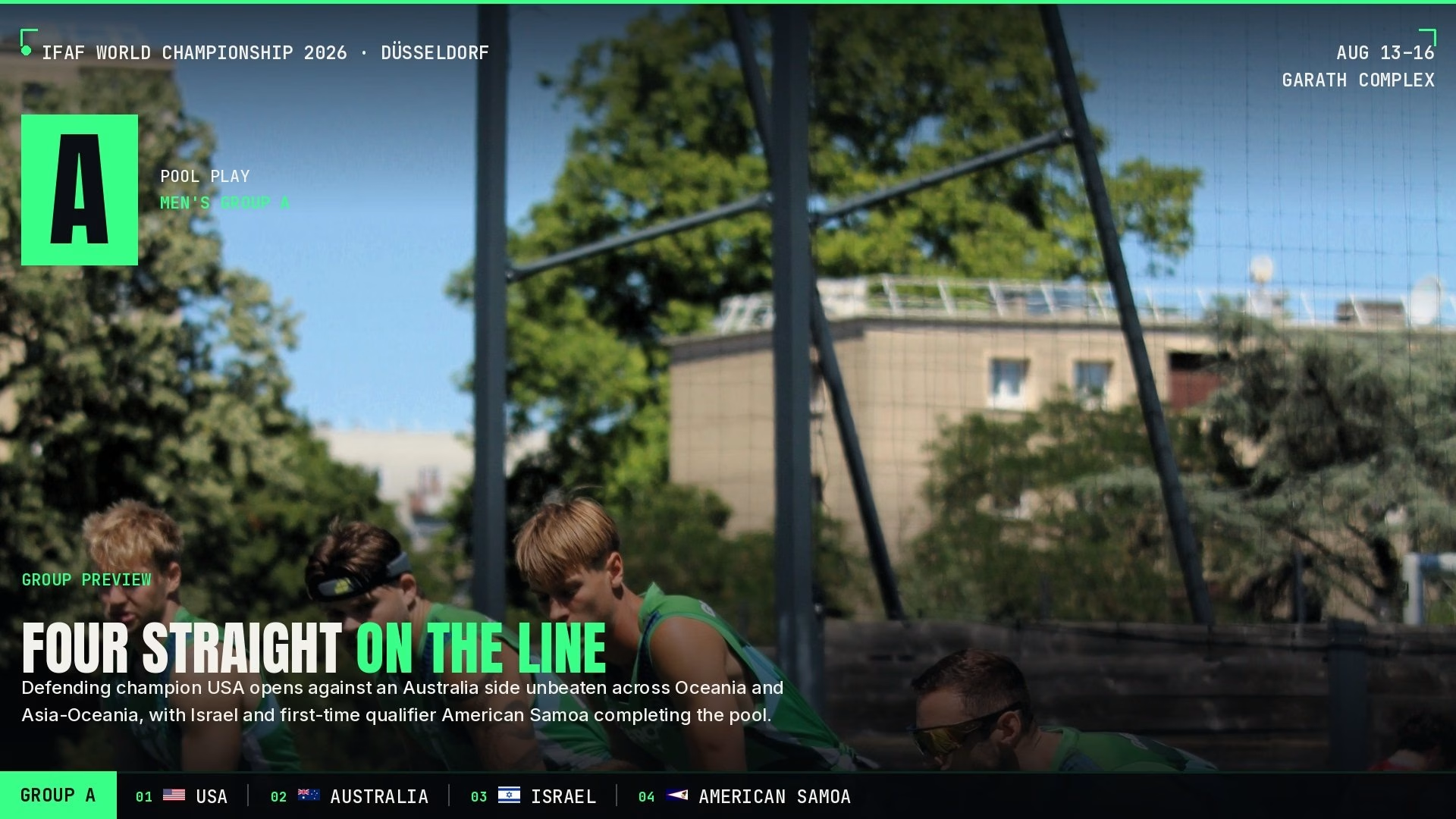
USA's gold machine, Australia's rugby experiment, Israel's unstoppable offense, and American Samoa's electrifying debut — the most American-influenced pool at the 2026 World Flag Football Championship.
Replace this div with <img src="player-6.jpg">
Group A at the 2026 World Flag Football Championship
When IFAF drew the groups for the 2026 World Flag Football Championship in Düsseldorf, Group A became the most talked-about pool in the field. Four programs, four completely different stories — and at least two of them capable of making serious noise in the knockout rounds.
At the top sits the United States: six world titles, the most dominant flag football program ever assembled, a system so deeply ingrained that personnel can rotate and the machine keeps rolling. Below them, the group tells the story of where world championship flag football is growing fastest — Oceania, the Middle East, and the Pacific Islands.
There's one thread that ties this entire pool together: American DNA. Every national team in Group A carries it. Whether it's players based and developed in the USA, athletes born stateside and repping heritage nations, or coaching staffs built on American flag and gridiron systems — the U.S. game is the operating system running underneath all four rosters. That makes Group A a uniquely revealing pool to study.
For the Ljubljana Frogs and every European program tracking the global flag football landscape, this is essential viewing. The teams and tactics on display in Group A will shape the sport for years — straight through to the LA28 Olympics.
🇺🇸 USA — The Gold Standard
There is no other starting point. The United States flag football program is the standard by which every other team in the world measures itself — six men's world titles, five of them consecutive. At Lahti 2024 they took down Austria 53–21 in the final, their most dominant championship performance in years.
What makes USA so difficult to game-plan against is that their dominance isn't built on any single superstar. It's systemic. Two- and three-man route concepts repped thousands of times. A defensive structure that shrinks every throwing window. Special teams units that manufacture short fields and turn them into automatic points.
And they're peaking at the right time. In the most recent Summer Series, the USA beat Canada by 30+ points — not a rivalry game, a statement. This is a team on the verge of winning it all again, and they look like the clearest WC26 favourite of any program in any group.
"The variables in Düsseldorf are less about talent and more about health, cohesion, and whether anyone can force them out of their comfort zone."
At the 2025 Americas Championships in Panama, they delivered one of the most dominant group-stage runs you'll see at that level: 5–0, including wins of 52–6, 54–0, and 64–18, before the gold-medal game against Mexico was abandoned due to lightning — handing them joint-champion status with zero meaningful stress tests heading into WC26.
The only realistic upset scenario? With the USA already locked into the LA28 Olympics as hosts, there's a theoretical chance they ease off the gas and let the guard down. We don't think it happens — and certainly not in the group stage, where the system carries them regardless of intensity.
🇦🇺 Australia — The Rugby Experiment
Two years ago, Australia played their first-ever men's World Championship in Lahti. They finished 15th. Most programs would treat that as a decent debut and gradually improve. Australia treated it as Year Zero — and then went and won the 2025 Asia–Oceania Championship in Ningbo outright.
The run itself is worth spelling out, because it's how they earned the No. 8 seed. Australia went a clean 4–0 through Oceania pool play, headlined by a 41–12 demolition of American Samoa, before taking the combined Asia–Oceania final 23–19 over Japan — the same Japan side that has historically pushed the European elite. Beating Japan to be crowned regional champions is the single result that legitimised the whole project.
What turned heads was how they did it. The American coaching influence was visible on the field — U.S.-style route concepts, defensive spacing, and structure that looked a level above where a debutant program should be. That's a compliment and a warning at once: it accelerated their rise, but it also drew eyes in the wrong direction, with plenty of observers asking how much of the success is homegrown identity versus borrowed system. In Düsseldorf, that question gets answered against the best in the world.
But the WC26 build-up has introduced a genuine wildcard: Australia is experimenting with rugby players. The athletic upside is obvious — elite speed, broken-field instincts, fearless running. The quarterback room reflects it, with Stegman and Pasquale built to run, throw on the move, and put enormous pressure on defenses with their legs. The last Summer Series in the States, though, did not go so well, and that's the warning sign.
Here's the risk in plain terms: speed wins you highlight plays, but flag football punishes incompletions and turnovers brutally. When you're built to run-and-gun and the ball hits the turf or goes the other way, it can bite you hard. Prioritising raw athletes over proven flag IQ — and over locker-room and on-field chemistry — can become a bigger problem than a solution.
Make no mistake about Australia's ambition. They are pouring funds, marketing, and PR into flag football because they want to run it back for Brisbane 2032 on home soil. But before any of that, they have to prove it in Düsseldorf. The experiment either validates itself here or it doesn't.
🇮🇱 Israel — Offense as an Ideology
If you want to understand Israel's flag football program, start with one number: 349. That's how many points they scored across seven games at the 2021 World Championships in Jerusalem — roughly 50 points per game. And they finished fourth.
The Kraft-backed flag scene in Israel has built one of the most cohesive offensive systems in the world over multiple tournament cycles. The same concepts, the same quarterback–receiver timing, the same willingness to take on any defense in a full-scale shootout — the roster names evolve but the style never does.
The WC26 build-up hasn't been without a complication. Their best player, Dani Eastman, is dealing with a calf injury — a real blow heading into training-camp competition, where reps and internal selection battles get decided. (Note: no national-team cuts have been made yet, so every name here is still fighting for a roster spot.) But the offense shouldn't miss a beat: led by Farkas and Mikhaelov, the unit has the timing and firepower to keep Israel in any shootout.
The defensive side is where it gets interesting. Tall blitzer Michael Tover can be a genuinely disruptive force off the edge — the kind of length and closing speed that makes life miserable for opposing quarterbacks and forces the rushed, low-percentage throws that swing flag games. If Israel can pair their offense with three or four Tover-induced stops, they're dangerous to anyone.
🇦🇸 American Samoa — Third Time a Charm?
American Samoa arrived at their first-ever IFAF continental championship in Ningbo 2025 as unknowns. They left as bronze medallists, World Flag qualifiers, and one of the most electric new programs in the sport — a 40–35 upset of New Zealand, a 12–41 reality check against Australia, then a 41–34 bronze-medal win over host China to clinch the WC26 spot.
Now they're picking up serious speed. Tai Tiedman has emerged as the quarterback running the show, and there's a rumour swirling that Taulia Tagovailoa — Tua's younger brother — is getting some reps with the program. If that holds, American Samoa suddenly carries real Polynesian-American football pedigree and a profile boost that punches well above a 33rd seed.
And here's the storyline that should have everyone watching: American Samoa has already faced Australia twice — and lost both. In Düsseldorf they could very well draw them a third time. Third time's a charm? In flag football's 40-minute, two-plays-can-flip-it format, a team that's seen you twice, studied the film, and has nothing to lose is exactly the kind of opponent that springs the upset.
The Battle for Second
Group A's outcome isn't really about first place — USA will take that comfortably. The tournament-defining game is who claims the second automatic quarter-final spot. That fight will almost certainly go through a head-to-head between Australia and Israel.
Group A Fixtures & What to Watch
The WC26 men's match schedule is out, and Group A's round-robin runs across the first two days in Düsseldorf. Every team plays the other three; the standings here set the quarter-final seeding. Below are all six Group A games — and the two that decide who advances behind the USA are tagged.
Why Group A Matters Beyond Düsseldorf
Israel's presence in Group A is equally instructive. Programs backed by strong domestic leagues and long-term system continuity can reach and stay in the global top 10 without the population of the USA or the federation budget of Germany. That's a message that resonates in Slovenia.
And American Samoa? Their story should motivate every small nation in the sport. Flag football's format is an equalizer. You don't need 50 players or a six-figure budget to qualify for a World Championship and win games there. You need speed, system clarity, a QB like Tiedman, and a mentality that treats every rep as a statement. That's exactly what the Ljubljana Frogs, with the International Frogs team program, bring to every game — and why watching WC26 flag football Group A is film study, not just entertainment.
Our Group A Final Standings Pick
Have Your Say on Group A
That's our read. Now it's yours. Vote for who wins the group — or drag the four teams into the exact final order you'd put money on. No login, no nonsense. Just call it.
- 1🇺🇸 USA⠿
- 2🇮🇱 Israel⠿
- 3🇦🇸 American Samoa⠿
- 4🇦🇺 Australia⠿
Ready to hit the field?
Join our diverse roster. No experience needed to start training with us.
Join the teamKeep Exploring
Continue the story
Jump from this article into the roster, match center, and content hubs that give the story more context.