You Are Not A Cyclist
Every sports nutrition product in Europe was designed for someone riding for five hours. Gels engineered for 90 g of carbohydrate an hour. Drink mixes built for the Tour de France.
Flag football is a different sport at the cellular level. A receiver runs a route in about five seconds, then stands for forty. Then does it again. Forty times a game. And at a tournament — three games in one day.
So the question is not "how do I fuel like Roglič." The question is: how do I still have my top-end speed in the fourth quarter of game three?
What Actually Powers A 5-Second Sprint
For a five-second maximal effort, one energy system does nearly all the work: the phosphocreatine system. Instant, explosive, and small. It empties in seconds and refills during your rest.
Your glycogen — stored carbohydrate in muscle — is the tank behind the tank. It is what lets the phosphocreatine system keep recharging, sprint after sprint. And it is what your brain runs on.
Here is what most players get wrong: you do not run out of carbohydrate in a single game. You run out across a tournament. When you do, three things happen at once — and only one of them is obvious.
- Your repeated-sprint output drops. You feel this.
- Your hands get worse. You half-notice this.
- Your decision-making degrades. You do not notice this at all.
is not slow. He is late.
Stop Measuring Grams. Nobody Has A Scale At A Hotel Breakfast.
Here is the honest problem with sports nutrition advice: it is written in grams per kilogram, and you are standing at a hotel buffet in Düsseldorf at 07:30 with a plate and no calculator.
So let us translate it into food. The science says an 80 kg player wants roughly 2–3 g/kg of carbohydrate three to four hours before kickoff — call it 160–240 g. Build any of these three plates and you land in the right zone.
- 3 slices white toast + honey or jam (~60 g)
- 1 large banana (~27 g)
- 1 bowl of cornflakes with milk (~40 g)
- 1 glass orange juice, 300 ml (~30 g)
- 1–2 boiled eggs or a small yogurt (protein)
- 2 croissants with jam (~70 g)
- 1 banana (~27 g)
- 1 bowl of porridge with honey (~50 g)
- Glass of juice (~30 g)
- Large bowl of white rice with honey or jam (~90 g)
- 2 slices toast + honey (~40 g)
- Banana (~27 g)
- Glass of juice (~30 g)
- Bacon, sausage, fried eggs, cheese. Fat slows gastric emptying.
- Wholegrain everything, bran, big salads, fruit skin. Fibre does the same.
- Anything you have never eaten before a game. Game day is not experiment day.
Juice over an orange. Everything you are normally told is "less healthy" is exactly right three hours before kickoff — because it empties from your stomach fastest.
⏱️ The 60-minute top-up
An hour out, you want something small, fast and boring: a banana, white bread with honey, or an energy chew. This is where sports products genuinely earn their money — engineered to absorb fast and not sit in your gut.
The Daily Target (For The Days You Plan)
For actual training weeks, the ACSM / Academy of Nutrition and Dietetics position stand gives this:
| Day type | Carbohydrate | 80 kg player |
|---|---|---|
| Rest / light | 3–5 g/kg | 240–400 g |
| Moderate (1h) | 5–7 g/kg | 400–560 g |
| Heavy / doubles | 6–10 g/kg | 480–800 g |
| Tournament day | 8–12 g/kg | 640–960 g |
You do not need to hit these to the gram. You need to know that most players eat a fraction of this and then wonder why their legs are flat by Thursday.
During The Game, You Probably Do Not Need A Gel
Honest answer, and it costs our sponsor a sale: for a single 40-minute game, in-game carbohydrate is not critical. You have enough glycogen. The strong evidence for fuelling during exercise applies to efforts over 60–90 minutes.
But a tournament is not a single game. By game two you are on a partial tank. By game three you are on fumes — and that is where fuelling between games becomes the difference between winning and watching.
That is an article of its own → Three Games, One Day: The Tournament Protocol
Are there cheaper alternatives? Yes.
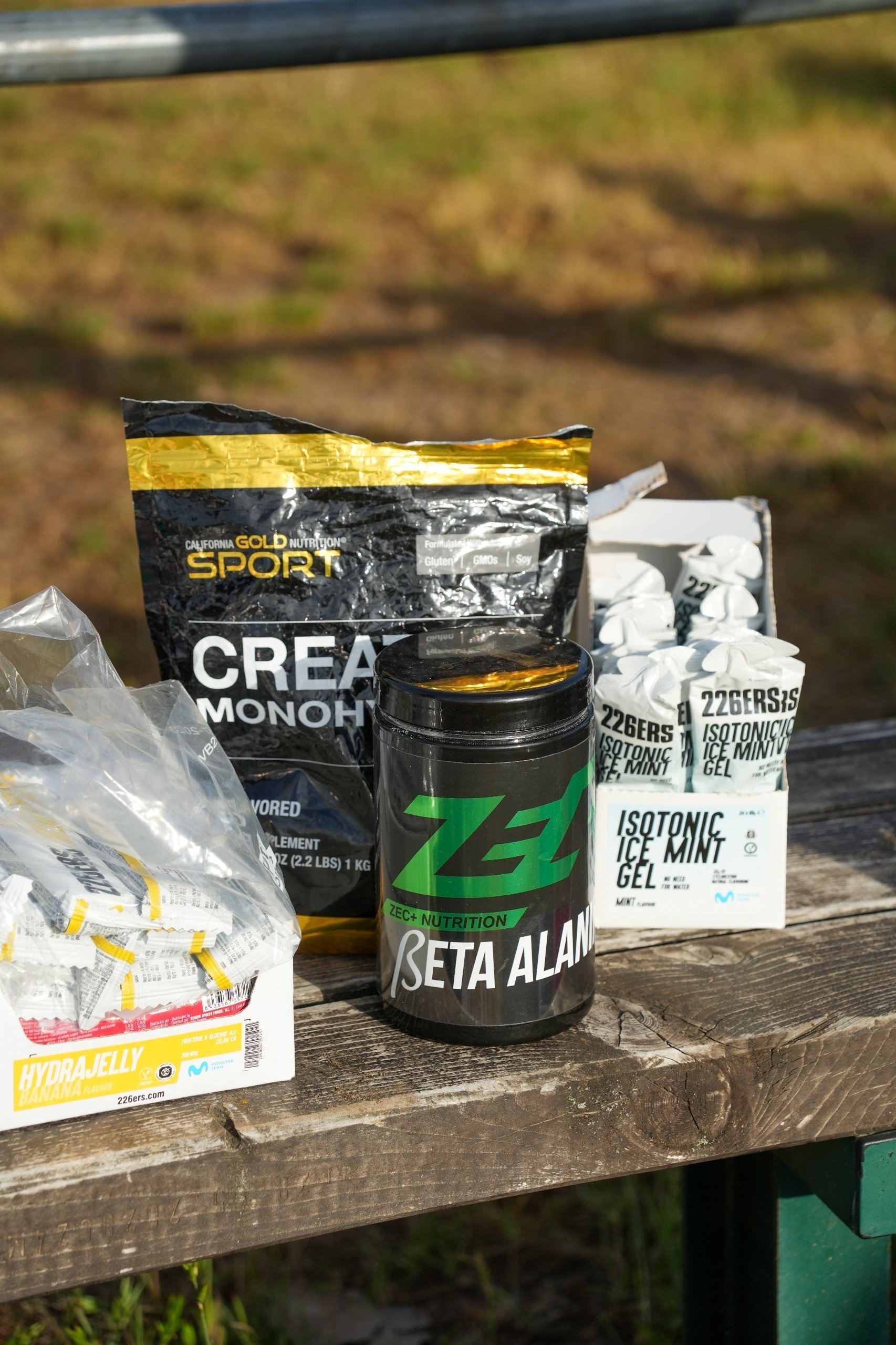
A banana and a bottle of squash with a pinch of salt will do most of what a €3 gel does. We are not going to pretend otherwise. So what are you actually paying for?
| You pay for | Why it matters in flag football |
|---|---|
| Gut tolerance | Engineered to absorb without cramping while you sprint. A sandwich is not. |
| Precise dosing | You know exactly what is in it. "Some juice" is not a dose. |
| Taste at hour six | The one people underrate. On game three, in 30°C, you will not eat solid food. You will drink something that tastes good — or you will eat nothing. |
| Portability | It fits in a sock. Rice does not. |
| Batch-testing | If you are on an LA28 pathway, this is not optional. See our supplements guide. |
Our honest position: eat real food 90% of the time. Buy products for the 10% where food genuinely fails you — and that 10% is the tournament.
30% off at LaPrimaFit · Basket €100 → you pay €70 → ships free
The €100 threshold is on the retail price, before your discount. So free shipping is easier to hit than it looks.
Order as a team. Six players splitting one order all get 30% off and free shipping. Nobody should pay shipping on a €30 solo order.
Shop The Range →Questions Players Actually Ask
What should I eat before a game — concretely?
Three to four hours before: white toast with honey or jam, a banana, cereal with milk, and a glass of juice. Roughly 160–200 g of carbohydrate for an 80 kg player. Keep fat and fibre low — no bacon, no cheese, no wholegrain. An hour before: a banana, or an energy chew. The counterintuitive part: white bread beats brown, jam beats butter, juice beats whole fruit. All the things you are told are "less healthy" are exactly right on game morning, because they empty from your stomach fastest.
Why does white bread beat wholegrain before a game?
Fibre slows gastric emptying. Wholegrain is genuinely better for you 364 days a year — but on game morning you want the carbohydrate out of your stomach and into your blood, not sitting in your gut while you run a post route. Same reason you skip the fried eggs: fat slows digestion.
Is chocolate milk actually good for athletes?
Yes, and it is not a gimmick. Chocolate milk lands at roughly a 3:1 or 4:1 carbohydrate-to-protein ratio, which is close to what a commercial recovery drink is engineered to deliver. It is cheap, it is everywhere, and the research on it as a post-exercise recovery drink is genuinely decent. The honest catch is that a purpose-built recovery drink is more concentrated, easier on the stomach after a hard game, and lets you hit the numbers precisely.
How many carbs do I really need per day?
3–5 g/kg on a rest day, up to 8–12 g/kg on a tournament day. For an 80 kg player that is 240 g on an easy day and potentially 640–960 g on a tournament day. Most players eat far less and blame their legs.
Do I need energy gels for a single 40-minute game?
No. You have enough muscle glycogen. Gels earn their place between games at a tournament, when you need to refuel fast and your stomach will not accept solid food.
Does low-carb dieting hurt flag football performance?
Badly. Low glycogen degrades repeated-sprint output, skill execution, and — most dangerously — decision-making. You will not feel slow. You will just find yourself a half-step late reading routes, and you will not know why.