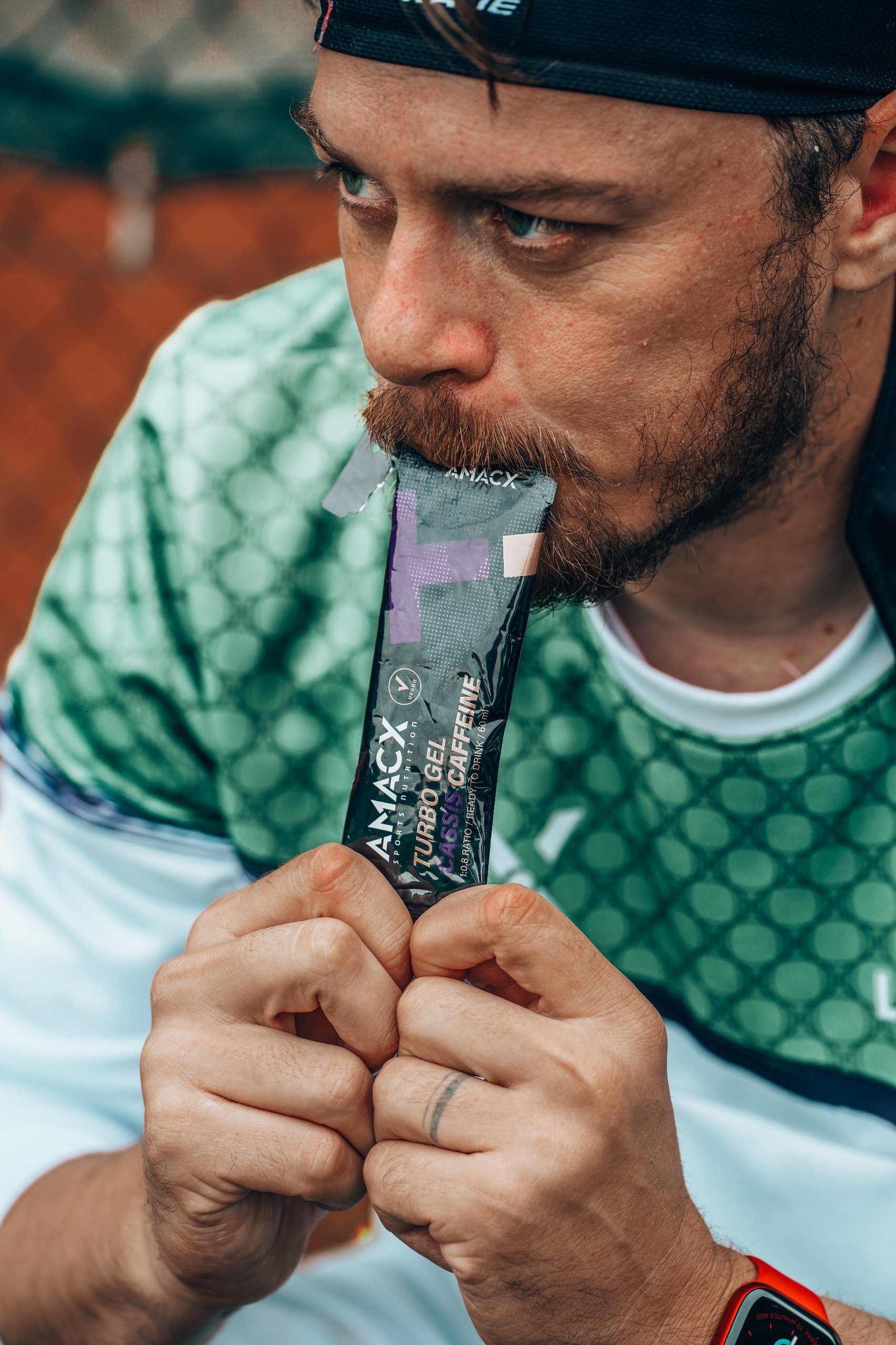
Cyclists Have Team Buses. You Have A Bag On The Grass.
Seven-player roster. Zero rotation. Three games in one day. Between games you referee someone else's game — so your "recovery window" is spent standing in the sun making decisions.
Then you do it again tomorrow.
Every sports nutrition product in Europe was built for someone riding for five hours. Nobody wrote the protocol for a wide receiver playing three games before dinner. So we did.
The One Number That Decides Your Tournament
per hour, in the first four hours after a game Established in the ISSN nutrient timing position stand
For an 80 kg receiver: 80–96 g of carbohydrate per hour between games.
Not "a banana." Not "a protein bar." Eighty to ninety-six grams, every hour.
Almost nobody hits this. Which is exactly why almost everyone is slow in game three.
What 90 g actually looks like
| Source | Carbs |
|---|---|
| 1 bottle isotonic drink (500 ml, mixed properly) | ~40 g |
| 1 energy gel | ~25 g |
| 1 banana | ~27 g |
| Total | ~92 g ✅ |
That is your hour. Bottle, gel, banana. Repeat next hour.
The protein detail everyone gets backwards
At 1.0–1.2 g/kg/h of carbohydrate, adding protein does nothing extra for glycogen. Protein only helps when your carbohydrate intake is below target — it partially compensates.
So: hit the carbs first. If you cannot, then add protein to cover the gap. Do not add protein instead of carbohydrate and think you have done the job. You have not.
The Problem With Your Stomach
Here is where it falls apart in practice. After a hard game in August heat, your appetite is gone, your gut has shut down, and someone hands you a chicken sandwich.
You will not eat it.
Liquid solves this. In the window between games, drink your carbohydrate.

- Isotonic drinks — carbs, fluid and sodium in one bottle. You can drink it while refereeing.
- Energy gels — two gels plus water is 50 g in under a minute.
- Energy chews — when you want something to chew but cannot face a meal.
The Caffeine Mistake That Ruins Day Two
Caffeine is the best-evidenced performance supplement in existence. The BJSM umbrella review — a review of reviews — found it improves strength, power, endurance, jumping and speed.
And for a defensive back, the killer application: it improves reaction time and vigilance. It sharpens the exact thing fatigue destroys first — your ability to read and react.
Drake and colleagues found that 400 mg of caffeine taken SIX HOURS before bed still cut objectively measured total sleep time by more than one hour.
Read that again. Six hours before bed. Still cost over an hour of sleep.
You win game three and lose the semi-final tomorrow.
The caffeine budget — treat it like ammunition
| Game | Dose (80 kg) | Why |
|---|---|---|
| Game 1 | Full: 3 mg/kg ≈ 240 mg | Max effect, plenty of time to clear |
| Game 2 | Low: 1–2 mg/kg, or gum | You are still carrying game-one caffeine |
| Game 3 — day 1 of a multi-day event | Minimal to ZERO | Protect tonight's sleep. This is the discipline that wins tournaments. |
| Game 3 — final day | Whatever you need | No tomorrow. Spend it all. |
No significant caffeine within 6 hours of sleep
Hour By Hour: The Tournament Day
- Carbs: 8–10 g/kg across the day. Pasta, rice, bread, potatoes — go heavy.
- Hydrate steadily. Urine pale.
- Last caffeine by early afternoon. Sleep is a performance supplement.
- Hotel breakfast plate: toast, honey, banana, cereal, juice. See our pre-game food guide.
- Creatine, if you take it.
- Caffeine 3 mg/kg.
- 300–500 ml fluid with electrolytes.
- Ice slurry if hot.
- Start drinking carbs immediately. Do not wait until you "feel like eating" — you will not.
- Target 1.0–1.2 g/kg/h: bottle + gel + banana per hour.
- Fluid and sodium to replace measured sweat loss.
- Caffeine: small top-up only if genuinely needed.
- Refereeing? Drink while you referee. You have a bottle. Use it.
- Same carb target.
- If the window is long and you cannot hit carbs, add ~20 g protein.
- Body-mass check — are you keeping up with fluid?
- The first 4 hours are the priority window. Carbs at ~1.2 g/kg/h, then a recovery drink.
- Rehydrate to ~150% of your fluid deficit — you lose some to urine.
- Zero caffeine.
- Sleep 8–10 hours. The highest-leverage recovery tool you have, and it is free.
- Total 24-hour carbohydrate matters more than precise timing now. Get to 8–10 g/kg.
- Repeat.
What A Tournament Actually Costs
Nobody publishes this. So here it is — a real basket for one two-day tournament, six games, 80 kg player.
| Item | Qty | Retail | Cost |
|---|---|---|---|
| Amacx Energy Drink 320g — covers the tournament | 1 tub | €14.95 | €14.95 |
| Amacx Drink Gel | 6 | €2.55 | €15.30 |
| Electrolyte caps | 8 | €1.00 | €8.00 |
| 6d Caffeine Gum | 1 | €4.30 | €4.30 |
| Bananas, white bread, honey | — | supermarket | ~€6.00 |
| Total (retail) | €48.55 | ||
| With code FLAGFOOTBALL | ≈ €34 |
| Approach | Per tournament | Per game |
|---|---|---|
| Supermarket only (bananas, squash, salt, chocolate milk) | ~€12 | ~€2 |
| Essential | ~€34 | ~€5.70 |
| Complete (adds recovery) | ~€43 | ~€7 |
| Complete + season supplements | ~€60 | ~€10 |
Are There Cheaper Alternatives? Yes.
We are a sponsored team writing on our sponsor's product. So here is our honest answer: a lot of this can be replicated from a supermarket.
| Product | Supermarket version | Does it work? |
|---|---|---|
| Isotonic drink | Squash + salt + sugar | Mostly, yes |
| Energy gel | Banana, honey sachet | For carbs, yes |
| Recovery drink | Chocolate milk | Genuinely yes — ~3:1 carb:protein |
| Electrolytes | Table salt | Yes, but you are guessing the dose |
| Protein powder | Chicken, eggs, Greek yogurt | Better, actually |
So why buy the real thing?
- Your stomach at hour six. This is the honest number one reason. On game three of day two, in 30°C, you will not eat a banana. You will not face chocolate milk. You will drink something cold that tastes good — or you will eat nothing at all. Taste is not a luxury at a tournament. It is the difference between fuelling and not fuelling.
- Gut tolerance. Engineered to absorb without cramping while you sprint. Squash and sugar is not.
- Precision. You know the dose. "Some salt" is not a dose.
- Portability. A gel fits in a sock. A bowl of rice does not.
- Batch-testing. If you have national-team ambitions, this is not optional. See our supplements guide.
Our actual recommendation: real food for everything you can. Products for the tournament window where food genuinely fails. That is the 10% worth paying for — and it is the 10% that decides games.
30% off at LaPrimaFit · Basket €100 → you pay €70 → ships free
The €100 threshold is on the retail price, before your discount. So it is easier to clear than it looks.
Tournament kit (~€48) + creatine (€29) + tart cherry (€6) = €100 retail → you pay €70, ships free.
Or: one team order. Six players × €65 = €390 retail. Everyone pays €45.50. Nobody pays shipping. Nobody on this roster should ever be paying shipping.
Build Your Tournament Kit →What Separates Good Teams From Teams That Fade
Questions Players Actually Ask
How much should I eat between games?
1.0–1.2 g of carbohydrate per kg of bodyweight, per hour. For an 80 kg player, roughly 90 g per hour — one bottle of isotonic drink, one gel, one banana. Every hour. The reason this number matters is that glycogen resynthesis has a ceiling rate: your muscles can only rebuild so fast, so if you miss the window you cannot make it up later by eating more. Miss it between game one and two, and you arrive at game three with a debt you physically cannot repay.
Why can't I just eat a big meal after the tournament?
Because glycogen resynthesis is both time-limited and rate-limited. The first four hours after exercise are when your muscle is most receptive — glycogen synthase activity and insulin sensitivity are elevated. Eat nothing for six hours and then a huge dinner, and you will rebuild some glycogen, but you will have lost the fastest window. On a single-day tournament, that window is the only thing standing between you and a flat game three.
Should I take caffeine before every game?
No. Front-load it: a full dose before game one, taper down, and take minimal or zero before an evening game on day one of a multi-day tournament. Caffeine has a 5–6 hour half-life, and research shows 400 mg taken six hours before bed still cost over an hour of sleep. You would be trading tomorrow's semi-final for today's group game.
Why does sleep matter more than the recovery products?
Because sleep is when almost all of the actual repair happens — growth hormone release, muscle protein synthesis, and the neural consolidation that keeps your reaction time sharp. In elite basketball players, sleep extension improved sprint times and shooting accuracy by around 9%. No supplement on the market produces a result like that. If you have to choose between a recovery protocol and an hour of sleep, sleep wins every time.
What if I genuinely cannot eat between games?
Drink your carbs — isotonic drinks or gels. If even that is impossible, use a carbohydrate mouth rinse: swill and spit. It will not refuel you, but the oral receptors signal your brain and high-intensity performance improves anyway. It is a fallback, not a plan.
Is water enough in a hot tournament?
No. With heavy sweat losses you need sodium. Drinking large volumes of plain water dilutes your blood sodium — that is hyponatremia, and in extreme cases it is fatal. Sodium also helps you retain the fluid you drink rather than urinating it straight out.
What does a proper tournament kit cost?
Around €34–43 with the FLAGFOOTBALL code — roughly €6–7 per game. A supermarket-only version costs around €12. The gap buys you gut tolerance, precise dosing, portability, and — most importantly — something you can actually stomach in game three.