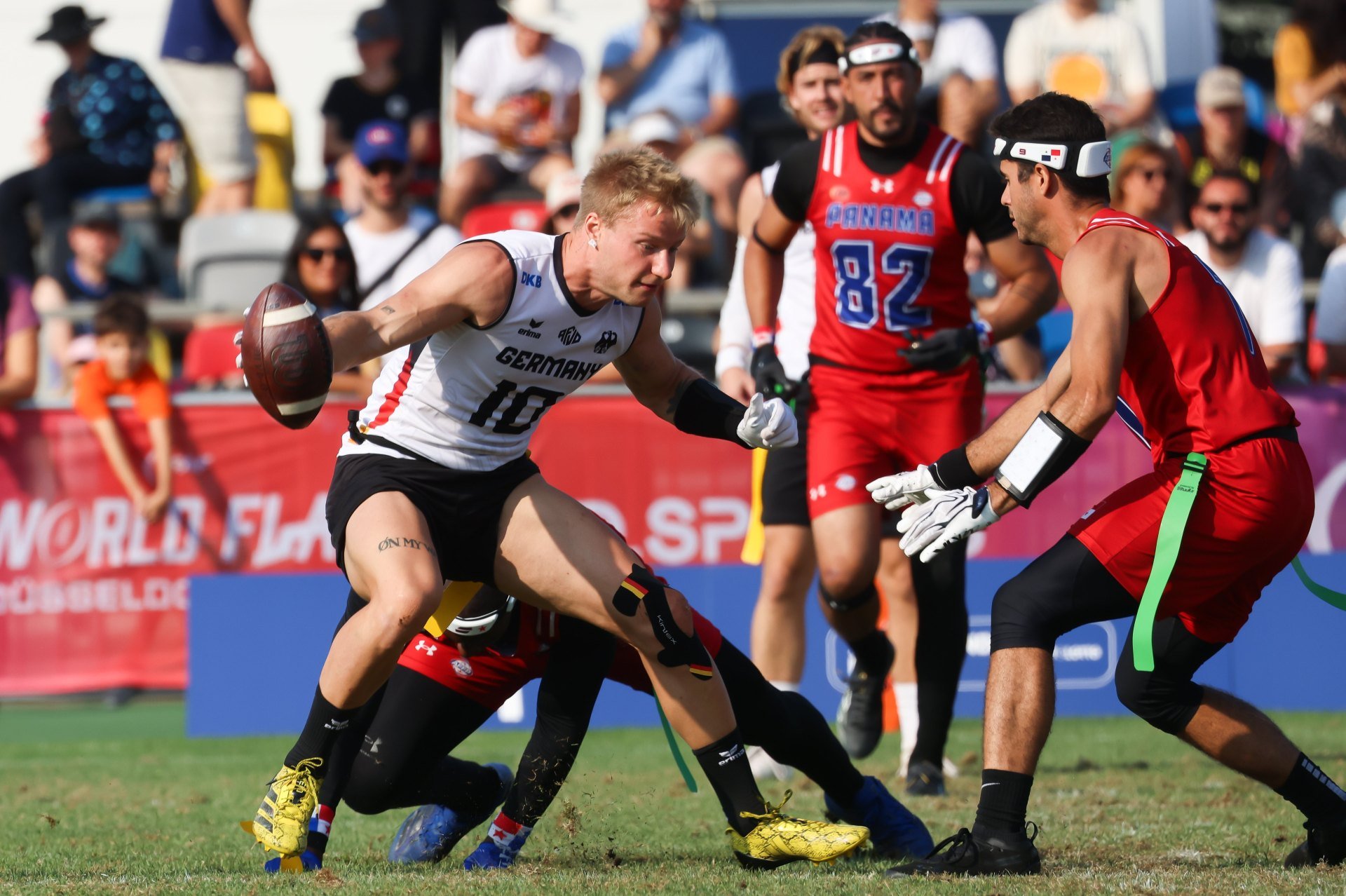
You have played basketball.
Or handball.
Maybe football, rugby, athletics, hockey or another sport.
You've seen flag football, watched a few games and thought:
"I could do that."
You probably can.
But becoming a good flag football player is a little more complicated than running fast and catching a ball.
That is one of the biggest misconceptions we see when athletes move into the sport.
Flag football looks simple from the outside.
It isn't.
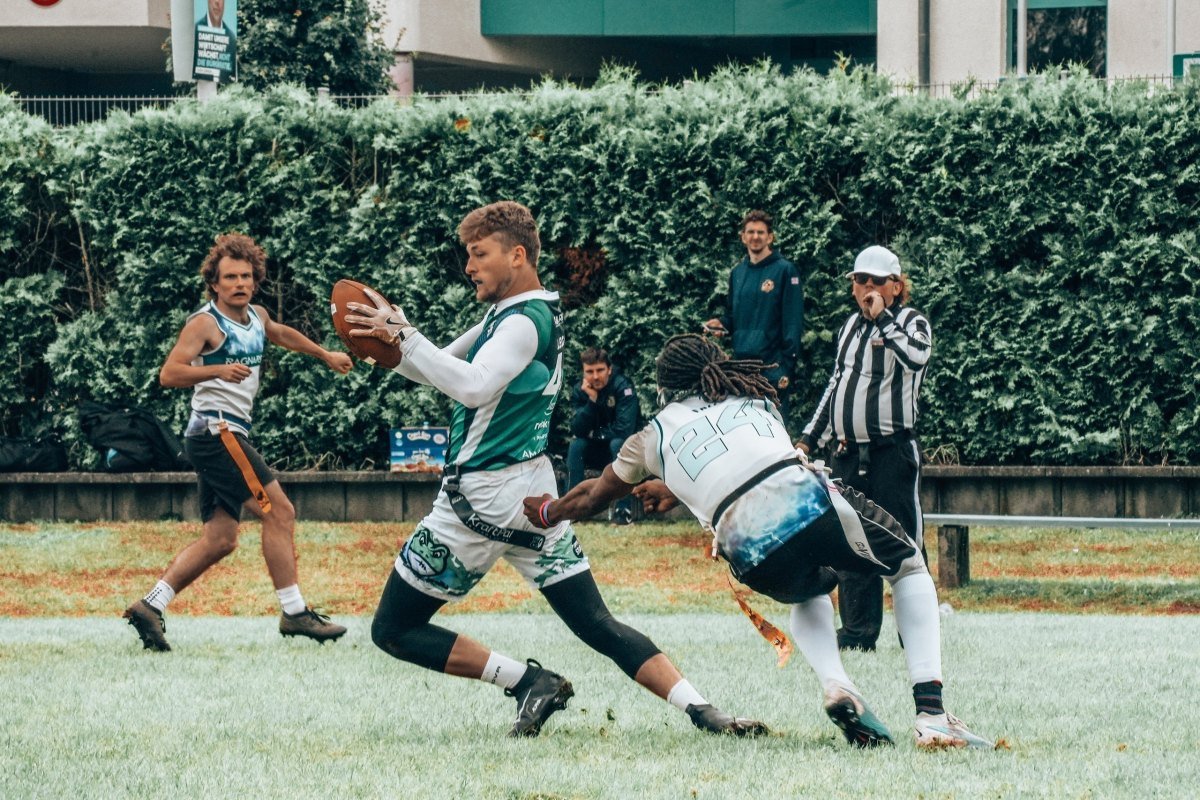
It is a demanding combination of acceleration, deceleration, change of direction, reaction, coordination, tactical understanding and repeated high-intensity effort. At competitive level, it is a real field sport — not simply a lighter version of tackle football.
At Ljubljana Frogs, our squad includes athletes from basketball, handball, athletics, martial arts and other sporting backgrounds. Previous flag football experience is not required; what matters is what you bring from your previous sport and how quickly you can turn those qualities into flag football skills. Our team accepts players without previous flag football experience.
There Is No Single "Flag Football Body"
Let's start with the part that usually gets people's attention.
If we create an idealized elite male flag football athlete, a useful reference profile might look something like this:
188 cm.
86 kg.
Around a 4.6-second 40-yard dash.
That combination gives you size, reach, acceleration and speed that can translate extremely well to the modern game.
But it is not a recruitment test.
It is not a minimum requirement.
And it certainly doesn't mean someone who is shorter, lighter or slower cannot become an excellent flag football player.
Flag football rewards different physical profiles at different positions. A center has different requirements from a wide receiver. A blitzer has different requirements from a safety. A quarterback may be one of the most important players on the field without being the fastest athlete on the roster.
The better question is not:
"Am I built like a flag football player?"
It is:
"What can I already do well, and what do I still need to learn?"
Think in Qualities, Not Measurements
Speed helps. Length helps. Explosiveness helps.
But the game also rewards anticipation, coordination, football intelligence, body control, communication and the ability to repeat high-quality actions throughout a tournament.
That is why athletes from very different sports can succeed.
The First Surprise: Flag Football Is a Sprint Sport
Flag football is played on a smaller field than traditional tackle football, but that does not mean the physical demand disappears.
Quite the opposite.
The game is built around short bursts.
Five yards.
Ten yards.
Twenty yards.
Sometimes forty.
Then stop.
Turn.
Accelerate again.
Change direction.
React to another player.
Go for the flag.
Run another route.
Do it again.
And again.
For a three-game tournament day, our working estimate is roughly 320 sprint efforts across the day, depending on position, playing time and the specific games. That number is not 320 maximal 40-yard sprints; it is a practical way of describing the enormous volume of short accelerations and high-intensity efforts that accumulate during a tournament.
The important pattern is:
short sprint → deceleration → change of direction → acceleration → recovery → repeat.
That is very different from simply being able to run a fast 100 metres.
Change of Direction Is a Core Skill
Running fast in a straight line is useful. Being able to stop, plant and redirect while maintaining control is even more important.
A receiver may create separation with a five-yard movement. A defensive back may have to close space and then react instantly to a cut. A blitzer may accelerate toward the quarterback and redirect as the play develops. A ball carrier can turn a short completion into a big play with one decisive change of direction.
That is why athletes from basketball, handball and hockey can sometimes adapt quickly. They already understand movement in space and have spent years stopping, starting, cutting and reacting.
What they still have to learn is how those movements fit into a flag football play.
Your Previous Sport Matters — But It Does Not Decide Your Position
One of the first questions new players ask is:
"What position will I play?"
The answer is usually: probably not the position you think.
Basketball Players
Basketball transfers extremely well to flag football. Footwork, acceleration, change of direction, spatial awareness, catching, reading defenders and finding open space all matter.
A basketball guard may have excellent movement qualities for receiver or defensive back. A taller athlete with reach and coordination may become particularly valuable on defense.
But basketball does not automatically teach route discipline. Getting open in flag football is not simply about finding space. It is about creating space according to a route, timing and the quarterback's read.
Handball Players
Handball players often arrive with a useful combination of explosiveness, coordination and spatial awareness. They are accustomed to moving at speed in tight spaces, finding passing windows and reacting to defenders.
That can translate well to receiver, center and defensive positions.
The challenge is learning the very different spacing and timing of flag football. A good handball movement does not automatically become a good flag football route.
Sprinters and Track Athletes
This transition appears obvious. Speed is valuable.
But being the fastest person at training does not automatically make you the best flag football player.
A sprinter may have an advantage over the first five or ten yards. The real question is what happens next.
Can You Do More Than Run Fast?
Can you change direction?
Can you react?
Can you catch?
Can you pull a flag?
Can you understand coverage?
Can you recognise a formation?
Can you repeat the effort when your legs are already tired?
Speed gets you into the conversation. It doesn't finish it.
Rugby Players
Rugby athletes often bring acceleration, agility, evasiveness and awareness of open space. They understand how to attack defenders and manipulate space.
But there is a major adjustment.
Flag football does not reward contact. You cannot run through people or create space through physicality.
You have to create separation with movement, timing and deception.
That is a very different skill.
Tackle Football Players
This can be the most complicated transition of all.
Tackle football provides a huge amount of useful knowledge: passing, routes, coverage, quarterback reads, defensive structure, football vocabulary and game awareness.
But flag football is not simply tackle football without tackling.
The spacing is different.
The rules are different.
The tempo is different.
The defensive priorities are different.
Some habits that worked perfectly in tackle football can become liabilities in flag football.
That is why the transition from tackle football to flag football is an adaptation, not a simple transfer.
Then There Is the Part Nobody Sees: The Rules
This is where many new athletes get a shock.
Flag football looks simple until you start playing it.
Then somebody explains the snap, line of scrimmage, eligible receivers, quarterback runs, rushing rules, down structure, no-run situations, penalties and the way a play develops.
Suddenly the game looks very different.
The Ljubljana Frogs flag football rules guide is a useful starting point, because it explains the basic 5-on-5 structure, downs, scoring and restrictions in plain language.
Competitive players eventually need to understand much more than the basics. That is part of becoming a complete player.
Everyone Wants to Be a Receiver
This might be one of our favourite beginner problems.
Yes, receiver is fun.
Catching touchdowns is fun.
Being in the highlight is fun.
But competitive teams need centers, quarterbacks, defensive backs, safeties, blitzers and players who can understand more than one position.
Everyone can catch in flag football. Everyone can defend. The value is in how well you understand the whole game and what your team needs from you.
The Game Is Fun. That Doesn't Mean It Is Easy on Your Body.
Flag football is a non-contact sport.
That does not mean it is an injury-free sport.
The physical stress does not come primarily from collisions. It comes from what your body has to do instead:
Repeated acceleration.
Sudden braking.
Hard changes of direction.
Jumping and landing.
Rotating.
Exploding out of a stance.
Reaching for flags.
Doing it again before the body has fully recovered from the previous effort.
That places a significant demand on the lower-body musculature and soft tissues.
The important point is not that flag football is inherently dangerous. It is that the preparation has to match the demands of the sport.
Playing for Fun and Training to Compete Are Different Things
This is where we see new athletes get into trouble.
They come to training. They have fun. They play a few games. Everything feels fine.
Then they arrive at a tournament and suddenly play three intense games in one day.
The body is not prepared for the accumulated workload.
The hamstrings are not prepared. The calves are not prepared. The adductors, ankles and other soft tissues are not prepared for hundreds of accelerations, decelerations and changes of direction.
That is when a sport that felt easy can suddenly feel very different.
You do not need to become a professional athlete before your first practice.
But you do need to gradually build the capacity to handle the sport.
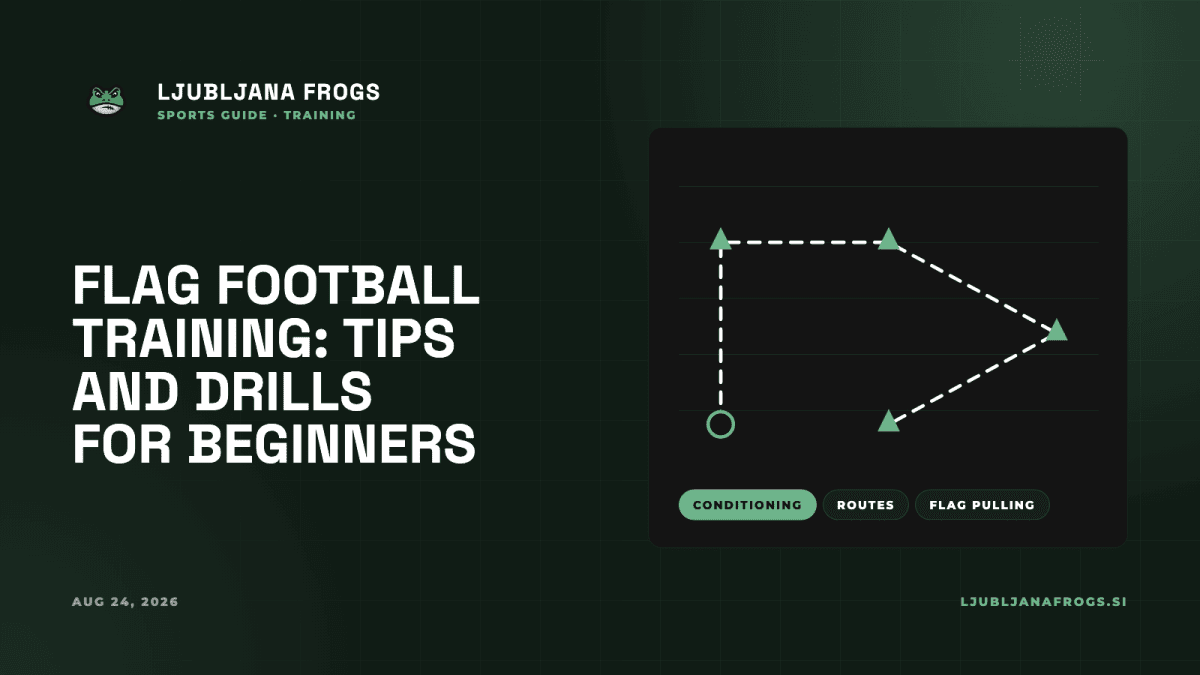
That means sprinting, strength training, mobility, change-of-direction work, conditioning and recovery, alongside regular exposure to the actual movement patterns of flag football.
Our current training structure reflects that approach. Ljubljana Frogs runs multiple sessions each week, including dedicated flag football work and separate sprint and technical sessions. Our beginner training guide covers the first physical and technical steps, while the rules guide gives newcomers a simple introduction to the game.
So How Do You Actually Make the Transition?
The process is simpler than many athletes think.
1. Bring What Your Sport Already Gave You
Your first advantage is not your flag football knowledge. It is the movement vocabulary you already have.
Bring your speed, coordination, footwork, catching ability, reaction, competitiveness, spatial awareness and experience working inside a team.
2. Learn the Game Before Trying to Master Your Position
Learn the rules. Learn the formations. Learn basic offensive and defensive concepts. Learn how the quarterback thinks. Learn why a center moves where they do.
The more you understand the whole game, the easier it becomes to understand your own role.
3. Train Regularly Enough for Your Body to Adapt
Consistency matters more than a heroic training week followed by two weeks of nothing.
Your body needs repeated exposure to acceleration, braking, cutting and football-specific movement before those actions become efficient.
4. Let Coaches Find Your Position
You may arrive believing you are a receiver and leave training looking much more interesting as a defensive back.
That is not a problem.
It is development.
5. Keep the Ego Out of the Process
Flag football rewards players who learn quickly and contribute to the team.
The best athlete is not automatically the best football player. The loudest player is not automatically the leader. And the person who scores the most touchdowns is not automatically the most valuable player.
Coachability, commitment and team-first behaviour matter.
The Best Background Is the One That Makes You Willing to Learn
There is no perfect previous sport.
There is no single perfect body type.
There is no perfect position.
And there is no shortcut around learning the game.
A basketball player can become a great receiver.
A handball player can become an excellent defensive back.
A sprinter can become an explosive playmaker.
A tackle football player can become an excellent quarterback.
And a complete beginner can surprise everybody.
At Ljubljana Frogs, we see former athletes arrive with very different backgrounds. What they have in common is not a perfect résumé. It is the willingness to train, learn and become part of a team. No previous flag football experience is required to start training with us.
Flag football is fun.
But at competitive level, it is also fast, technical, tactical and physically demanding.
Once you understand that, the sport becomes even more interesting.
And that is exactly where the fun begins.
You bring the athlete.
We'll teach you the flag football player.
Start your first week with Ljubljana Frogs.
<figure class="article-figure"><img src="media:IMG_3266.JPG" width="1920" height="2881" alt="I M G 3266" loading="lazy" decoding="async"></figure><p><br></p> <figure class="article-figure"><img src="media:IMG_3232.JPG" width="1920" height="2880" alt="I M G 3232" loading="lazy" decoding="async"></figure><p><br></p>
Ready to hit the field?
Join our diverse roster. No experience needed to start training with us.
Join the teamFollow the Frogs on Instagram
Training clips, matchday moments, and the road to LA28 — join 10K+ followers keeping up with the team between games.
Follow @ljubljanafrogs_flagfootballKeep Exploring
Continue the story
Jump from this article into the roster, match center, and content hubs that give the story more context.
Content hub
Sports Guide
See more reporting, analysis, and related stories from this track.
Open hubPlayer profile
Aljoša Kous
Move from the article into the player page, profile details, and season context.
Open profileLatest result
Sentinels vs Ljubljana Frogs — Domestic team
Open the result page for score context, then drill into the match center if needed.
Open result