
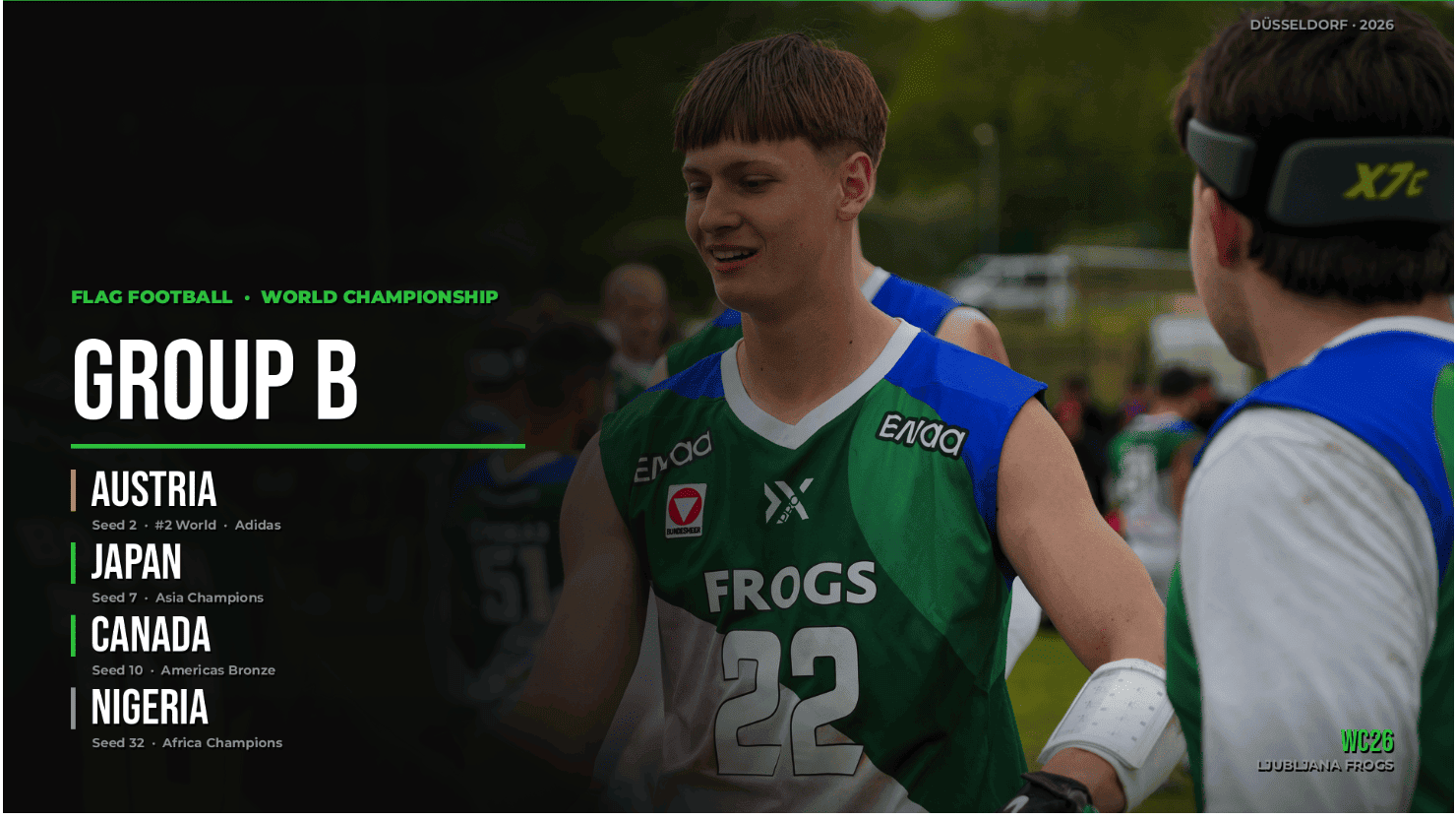
Group B at the 2026 World Flag Football Championship
If Group A is the story of USA's dynasty, Group B is the story of everything trying to happen around it. Austria — three-time world champions and the most consistent finalist program outside the USA — arrive in Düsseldorf with a freshly signed Adidas partnership and one of the rarest offensive concepts in the sport on the table.
Opposite them: Japan coming off a revealing summer trip to Germany, Canada leaning on a wave of CFL imports, and Nigeria making history as Africa's first-ever World Flag qualifiers — and reigning African champions, men's and women's both. Every game in this group matters. Every game will be closer than the seedings suggest.
Austria Goes Three Stripes
It's not just optics. A major kit deal of this scale typically comes with performance apparel integration, training kit supply, and visibility commitments — meaning Austria's players will be geared, supported, and very visible in Düsseldorf.
🇦🇹 Austria — Serial Finalists, New Chapter
Nobody outside the USA has been closer to a world title for longer than Austria. Three historical world golds and two recent silvers back up that reputation. But their most recent continental result is a reminder that "closest to the throne" doesn't mean "on it": at Euro Flag 2025, Italy beat Austria 27–19 in the gold-medal game, denying them the European crown. Austria go into Düsseldorf as European runners-up, not champions — and that distinction matters for how hungry this group should expect them to be.
The Vienna Vipers Core
The spine of this Austria roster still comes from Vienna Vipers, and that's not a coincidence. Ehrenfried, Stur, Knoll, and Wasshuber arriving at a World Championship having spent years in the same club system isn't just a roster decision — it's a tactical foundation built on trust and repetition.
⭐ Vienna Vipers core · 🆕 Notable additions
There's a genuine surprise buried in this roster, too — a handful of expected names are missing from the final Austria squad heading to Düsseldorf. Whether that's injury, form, or a coaching decision to go younger and more mobile isn't entirely clear yet, and it will be worth watching how the rotation shakes out once games start.
The Triple QB Scheme — Rarer Than It Sounds
Plenty of federations want a triple-QB scheme. The problem is supply: there simply aren't that many good, mobile quarterbacks in Europe, let alone concentrated in one country. If Austria can genuinely run three capable QBs through their rotation, it says as much about the depth of Austrian flag football right now as it does about any single game plan.
Between the missing names and the ambition of the scheme, there's real uncertainty attached to this Austria roster in a way there hasn't been in previous cycles. And yet — we still think Austria possess too much accumulated quality and championship experience not to win this group outright. Our call: Austria finish 3–0 in Group B.
🇯🇵 Japan — Katanas in Germany
Japan gave Europe an early look at their WC26 form in June, when the national team travelled to Germany for Big Bowl and squared off against Walldorf Wanderers. The two sides actually met twice — and split the story in an interesting way.
In the exhibition, Japan won comfortably — their defense, led by Ryohei, was suffocating, and the quarterback play alongside #19 was, frankly, scary good. But when the two teams met again at Big Bowl itself, in the tighter 2×12 minute format, Walldorf Wanderers turned the tables and got the win. That split result is a useful data point: Japan can be elite in longer, cleaner formats, but tighter windows expose the margins.
Our honest read on Japan is that they tend to overcomplicate their offense with RPOs. It's a sophisticated approach on paper, but flag football punishes even small mental errors severely, and that tendency is exactly what we expect to cost Japan a game in this group. Add in the Asia–Oceania final loss to Australia (19–23) — a result that, on paper, should never have happened — and Japan arrive in Düsseldorf with something to prove and a "katana and samurai attitude" they'll be leaning on hard.
Against Canada specifically, we like Japan. They'll give up size at the line and in contested catches, but they're simply too quick, shifty, and methodical for Canada's more straightforward vertical approach to consistently contain. Our projection: Japan finish 2–1 — a loss to Austria, wins over Canada and Nigeria.
🇨🇦 Canada — The CFL Gamble
Canada's roster build for this cycle has been genuinely unusual: they brought in a group of CFL players, several of whom had never played flag football before. That's a bold swing on raw athleticism over flag-specific experience, and the results so far have been a mixed bag.
The hard reality check came against USA at the Summer Series, where the gap in flag-specific execution was obvious. Domestically, Canada also lost by 10 points to the Montreal Braves at their national championships — notable because the Braves are stocked with several players who were actually cut from the national team roster. That's not a great look heading into a World Championship.
The counter-argument: Canada then traveled to China and went 4–0 against China and Australia, which suggests real quality is in there once the group finds rhythm. The question is whether that rhythm — and the flag football learning curve for the CFL imports — will be far enough along to match Austria's experience or Japan's speed.
We'd genuinely like to be wrong here, but a 1–2 record feels like the right call. Almost everything hinges on quarterback O'Connor and ball security. From what we've seen on film, he throws into the opposition's hands a little too often for comfort against defenses this disciplined.
🇳🇬 Nigeria — Africa's Champions, Not Just a Debut
That changes the framing entirely. Nigeria don't arrive in Group B as beaten underdogs — they arrive as reigning African champions with a signature win already on the résumé. Quarterback Hayes Obinna-Uzoh has been singled out by IFAF as the player to watch for the men's national team, while Folawiyo Farouk and center Edidong Udombat both scored touchdowns in the championship final against Egypt. The program is led by head coach Ephraim Fagha Faloughi.
Even with that context, Group B remains an enormous jump in competition level. Austria's triple-QB ambitions, Japan's speed and RPO-heavy scheme, and Canada's CFL-fuelled athleticism are three completely different problems, and Nigeria will see all three inside three days at World Championship tempo — a level up from anything the African continental circuit currently offers.
Realistically, we still project Nigeria to finish 0–3 in this group. But "reigning African champion" is a very different starting point than "unknown debutant," and a program that just beat Egypt for a continental title on Egyptian soil should not be dismissed as a guaranteed non-factor.
What Group B Tells Us About Europe
From our perspective as a Slovenian flag football club competing in the same European ecosystem as Austria, Group B carries a specific message: the gap between the top European programs and the rest of the world is closing, but the gap at the very top of Europe itself — between Austria and Italy, most recently settled 27–19 in Italy's favour — is razor thin.
Austria's ambition with the triple-QB scheme, even if the concept remains rare outside Mexico and the USA, is a blueprint every European program should study. The scarcity of mobile QBs across the continent is real, and any federation that can develop even two reliable options is ahead of most of Europe.
Kit deals — Adidas on Austria, Nike on Canada, Under Armour on Japan — confirm flag football at World Championship level is now firmly on the radar of the biggest sportswear brands. LA28 isn't an aspiration anymore. It's a commercial reality, and the gear on the field in Düsseldorf is the proof.
Build Your Own Prediction
Think you've got a better read on Group B than we do? Click the four teams below in the order you think they'll finish, then compare your ranking against our official pick.