Key facts
- IFAF allows a switch to any nation whose passport you hold — but it is permanent, and it covers flag and tackle.
- A DNA ancestry test is not proof of citizenship. IFAF requires a passport issued by the competent authorities.
- Bye-law 2 to Rule 41 of the Olympic Charter blocks you from the Olympic Games for three years — not from continental or world championships.
- LA28 is July 2028. The three-year cutoff falls around mid-2025.
- Brisbane 2032 opens 23 July 2032. The cutoff falls around summer 2029 — a clean window with no waiver required.
- Flag football is not yet confirmed on the Brisbane 2032 programme.
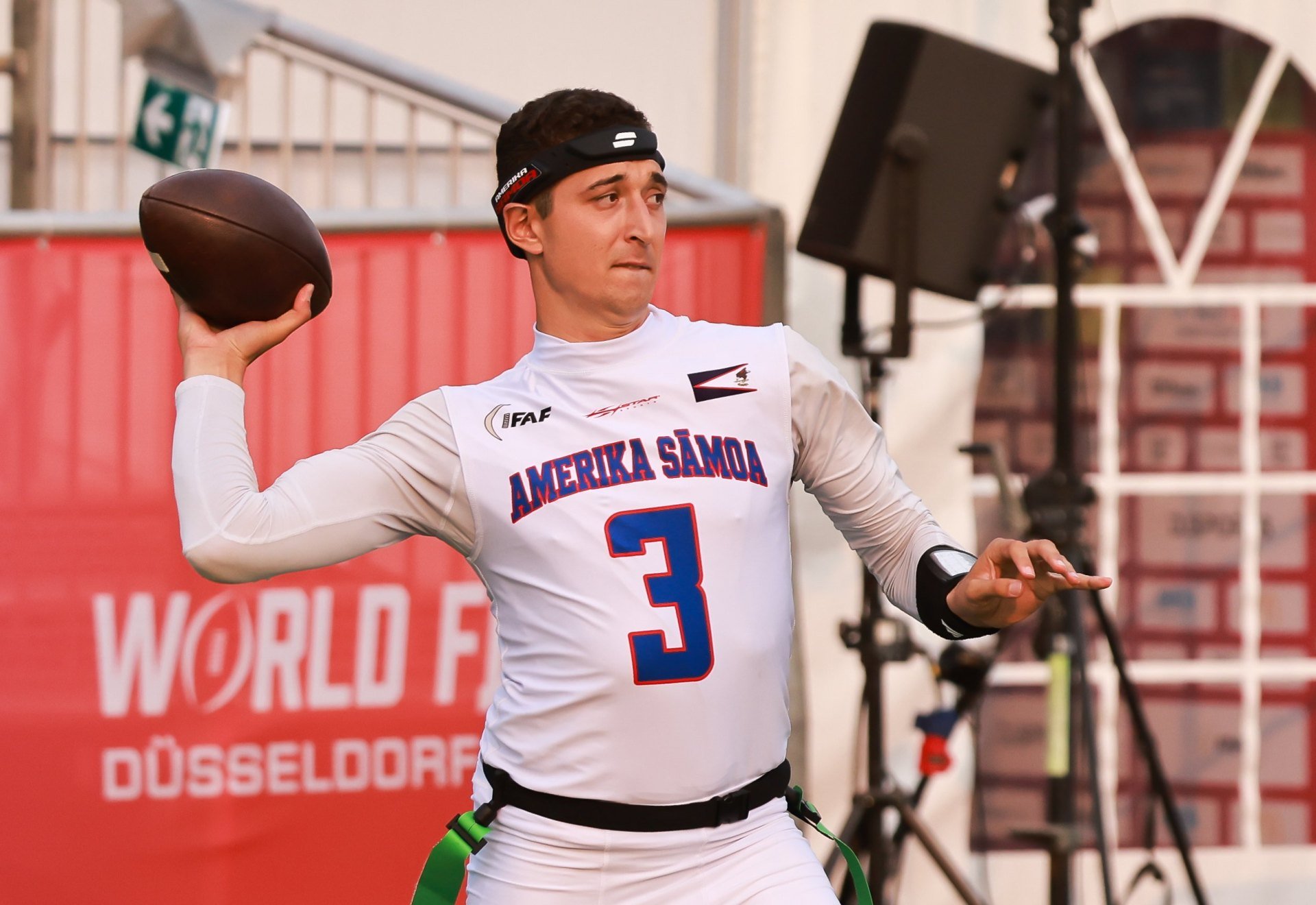
A lot of players didn't get the call-up for Düsseldorf. Plenty of them hold two passports. So the question landing in my DMs all month: can they switch national teams?
Yes. They can. IFAF allows it and the process is short.
But there are two rulebooks here, not one, and they run on completely different clocks. IFAF decides whether you can play for a new country. The International Olympic Committee decides whether you can play for that country at the Olympic Games. Separate gates, separate timelines — and clearing the first tells you nothing about the second.
Can you switch national teams in flag football?
Yes. A player may represent a second national team of any country whose nationality they hold. The switch must be notified to the IFAF Executive Board before the tournament, and the player must have been eligible for the new nation by 1 January of the competition year. The switch is permanent: once made, the player can never represent the country they left, or any third country.
That's the whole IFAF answer. The complications start with the passport, and they finish with the Olympics.
A DNA test is not a passport
This needs saying, because it keeps coming up. Ancestry tests have become a popular way for players to go looking for a second country. They do not work for this.
What IFAF actually requires
A DNA test returns an ethnicity estimate against a reference population. It is a probability, not a legal status, and no consular office anywhere accepts one as evidence of citizenship. IFAF's regulations are explicit: every player in IFAF, world or official competitions must present an individual passport issued by the competent authorities of the country they represent. A passport — not a heritage certificate, not a family story, not a percentage on a results page.
Citizenship by descent is narrowing
Citizenship by descent runs on documents: an unbroken paper chain of birth, marriage and death certificates through the ancestral line. And those routes are closing.
Italy: parent or grandparent only
Italy is the most-used descent pathway in European sport. It used to allow claims through a great-great-grandparent. Decree-Law 36/2025, converted into Law 74/2025, cut that to a parent or grandparent born in Italy, and Italy's Constitutional Court upheld the reform in 2026. Players who would have qualified in 2024 do not qualify now.
Sort the passport before you plan anything else. Everything below assumes you already have it.
The switch is a one-way door
The single most misunderstood part of IFAF's regulations: you are not choosing a team. You are spending the only switch you get.
Represent a second nation and you are permanently locked out of the first one and out of any third nation you might hold a passport for. There is no route back after a bad cycle, a coaching change, or a falling out with a federation.
Flag and tackle are one pool
Eligibility sits at federation level, not format level. Play flag football for Slovenia and you cannot later play tackle for Italy. The regulations do carve out other sports entirely — a dual-passport athlete can represent a different nation in a sport outside IFAF's jurisdiction with no consequence here.
The Olympic Charter doesn't stop you playing. It stops you playing at the Games.
Here's the part almost nobody has read properly.
The bye-law to Rule 41 of the Olympic Charter states that a competitor who has changed nationality may participate in the Olympic Games for their new country only once at least three years have passed since they last represented their former country. The restriction applies to the Olympic Games specifically. Continental championships, world championships and other IFAF competitions are governed by IFAF's own eligibility rules, not the Charter.
The trap: eligible for continentals, blocked at the Games
Switch tomorrow and, under IFAF's 1 January test, you can wear the new jersey at a European championship next season. You can play a World Championship. For two years everything looks settled — new federation, new roster, playing time, results.
Then the Olympics arrive and the IOC says no.
The three-year period is measured to the date you actually compete at the Games, not to the year, and it counts from the last time you represented your old country. Playing for the new one doesn't restart it or affect it. That clock is already running from the moment you last pulled a flag in your former jersey.
The practical version: you could help your new country qualify for the Olympics and not be entered for the tournament itself.
What the LA28 clock actually looks like
Flag football at Los Angeles 2028 is scheduled for July 2028. Count back three years and the cutoff sits around mid-2025.
So run your own dates. If you represented your current nation at the World Championship in Düsseldorf in August 2026, you are outside the window for a different nation at LA28. IFAF would clear you to switch and to play continental football. The IOC would not clear you for the Games.
The waiver route
There is a waiver. Bye-law 2 to Rule 41 lets the IOC Executive Board reduce or cancel the three-year period, and it does get used — in June 2026 the Executive Board approved three changes of sporting nationality ahead of LA28, across judo, athletics and fencing, granting exactly this exemption.
What a Rule 41 waiver requires
- Approval from the international federation.
- A release from your former National Olympic Committee.
- Acceptance from your new National Olympic Committee.
- A decision by the IOC Executive Board, which meets roughly quarterly.
That is not a formality. The federation you just walked away from has to sign a document letting you go. It's a negotiation with the people you left.
The Brisbane 2032 window nobody is talking about
Now invert the three years, because this is the genuinely useful part for anyone who just missed a call-up.
The Brisbane Olympics open on 23 July 2032. Count back three years and you land in the summer of 2029.
The five-step timeline
- Play out the entire LA28 cycle for your current country — every continental championship, every Worlds, right through 2028.
- Stop representing that country by mid-2029.
- Switch to the second nation.
- Keep playing continental and world championships for the new country while the clock runs — those aren't Olympic events.
- Arrive at Brisbane 2032 fully eligible, with no waiver, no release letter and nothing to negotiate.
If you didn't get the call this year, you aren't late. You're early. LA28 was never a realistic switch window for anyone who played international football in 2025 or 2026. Brisbane is.
The eligibility clock, side by side
| LA28 | Brisbane 2032 | |
|---|---|---|
| Games date | July 2028 | Opens 23 July 2032 |
| Rule 41 cutoff (last appearance for former nation) | ~mid-2025 | ~summer 2029 |
| Played Düsseldorf 2026 for your current nation? | Blocked without an IOC waiver | Clear, no waiver needed |
| Can you play continentals for the new nation meanwhile? | Yes — IFAF rules apply | Yes — IFAF rules apply |
| Flag football confirmed on the programme? | Yes | No — decision pending |
The Brisbane caveat you have to take seriously
Flag football is not confirmed for Brisbane 2032. It reached Los Angeles as one of five sports added at the host organisers' request, and host-city additions don't automatically carry to the next Games. The IOC is actively trimming the programme — president Kirsty Coventry has stated Brisbane will not carry the 36 sports Los Angeles will, and flag football has been named in reporting among the sports at risk alongside lacrosse and squash. The decision is expected within months.
The strategy above is real and the timing is right, but the destination isn't confirmed. Don't spend a permanent, one-time switch on a Brisbane plan until the sport is actually on the Brisbane programme.
So should you switch?
These are hard decisions and I'm not going to pretend otherwise. Maybe you get the call next year. Maybe you don't. Either way the answer is the same: play at the highest level you can find, every single time you get on a field. That's what gives you a chance at all. Keep the competitive mind, have fun with it, and remember a federation is one part of the journey, not the whole thing.
Five questions to answer first
- What are your actual goals — a roster spot, a medal, a career?
- What age are you at, and how many cycles do you realistically have left?
- Will you get real playing time, or are you swapping one bench for another?
- Is there a team being built around you, or are you a body on a roster?
- Can you make three players on that national team better by walking in the door?
Check more boxes than you don't and you already have your answer.
Frequently asked questions
Can a dual-national player switch national teams in flag football?
Yes. IFAF allows a player to represent a second national team of any country whose nationality they hold, provided the change is notified to the IFAF Executive Board before the tournament and the player was eligible for the new nation by 1 January of the competition year. The switch is permanent.
Does switching national teams affect tackle football too?
Yes. IFAF eligibility is not discipline-specific. Flag and tackle sit in the same pool, so representing a nation in flag football locks your tackle eligibility to that same nation. Sports outside IFAF's jurisdiction are unaffected.
What is the Olympic three-year cooling period?
Bye-law 2 to Rule 41 of the Olympic Charter requires that at least three years pass since a competitor last represented their former country before they may participate in the Olympic Games for a new country. The IOC Executive Board can reduce or cancel this period with the agreement of the international federation and both National Olympic Committees.
Can you play continental championships during the three-year cooling period?
Yes. Rule 41's restriction applies to the Olympic Games. Continental and world championships are run under IFAF's own eligibility rules, so a player who has switched can compete in them while the Olympic clock runs.
Is a DNA ancestry test enough to prove eligibility for a national team?
No. A DNA test provides an ethnicity estimate, not a legal status. IFAF requires an individual passport issued by the competent authorities of the country the player represents.
Is flag football confirmed for the Brisbane 2032 Olympics?
No. Flag football was added for Los Angeles 2028 at the host organisers' request. The Brisbane 2032 programme has not been finalised and the IOC has signalled it will be smaller than LA28's 36 sports. A decision is expected within months.
This is not legal advice. Confirm your position with your national federation and, where the Olympic pathway is in play, with your National Olympic Committee, before committing to anything. Rules stated here are current as of September 2026; both the Brisbane programme and IFAF's Olympic-cycle criteria are subject to change.
More on the international picture: our flag football World Championship 2026 results covers the full 16-team placements from Düsseldorf, plus group previews for WC26 Group A and WC26 Group C. The Ljubljana Frogs field a roster drawn from more than 15 nationalities across the European circuit — get in touch if you want to train in that environment.
Ready to hit the field?
Join our diverse roster. No experience needed to start training with us.
Join the teamFollow the Frogs on Instagram
Training clips, matchday moments, and the road to LA28 — join 10K+ followers keeping up with the team between games.
Follow @ljubljanafrogs_flagfootballKeep Exploring
Continue the story
Jump from this article into the roster, match center, and content hubs that give the story more context.
Content hub
News
See more reporting, analysis, and related stories from this track.
Open hubPlayer profile
Otto Močnek
Move from the article into the player page, profile details, and season context.
Open profileLatest result
Sentinels vs Ljubljana Frogs — Domestic team
Open the result page for score context, then drill into the match center if needed.
Open result