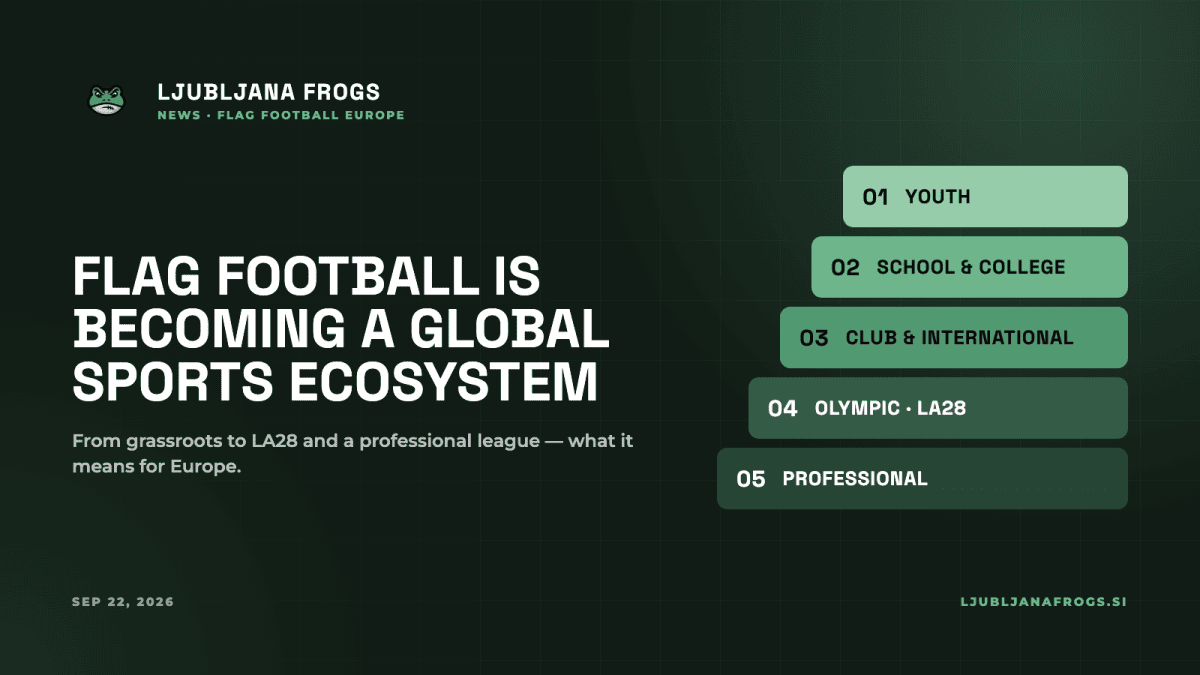
The ecosystem is already changing
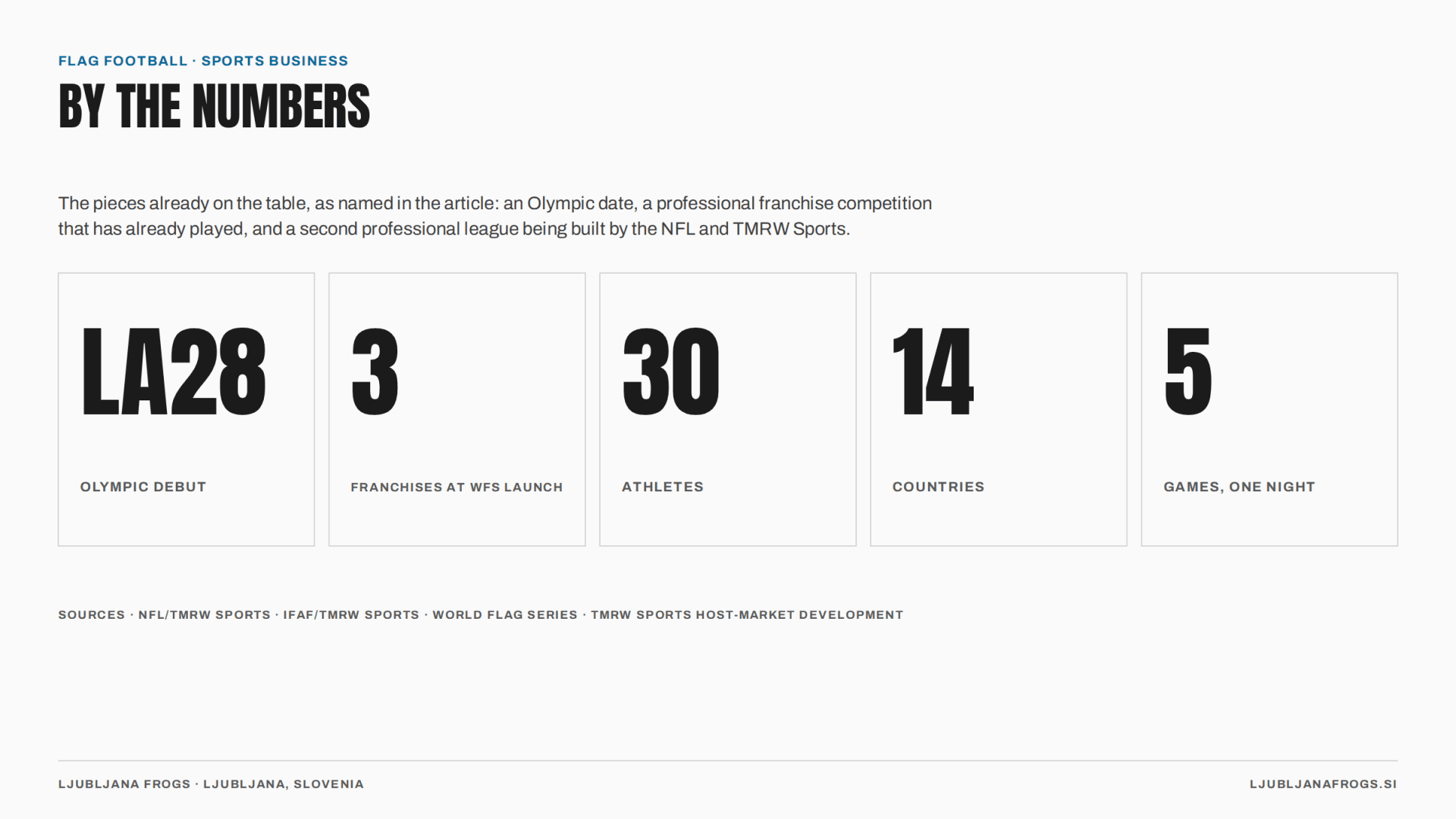
World Flag Series has launched professional franchise competition. The NFL and TMRW Sports are developing a separate professional men's and women's flag football league. IFAF and TMRW Sports are working together on athlete development, competition pathways and fan engagement.
Flag football is also heading to its Olympic debut at LA28.
1. What will the league system look like?
This may be the biggest unanswered question.
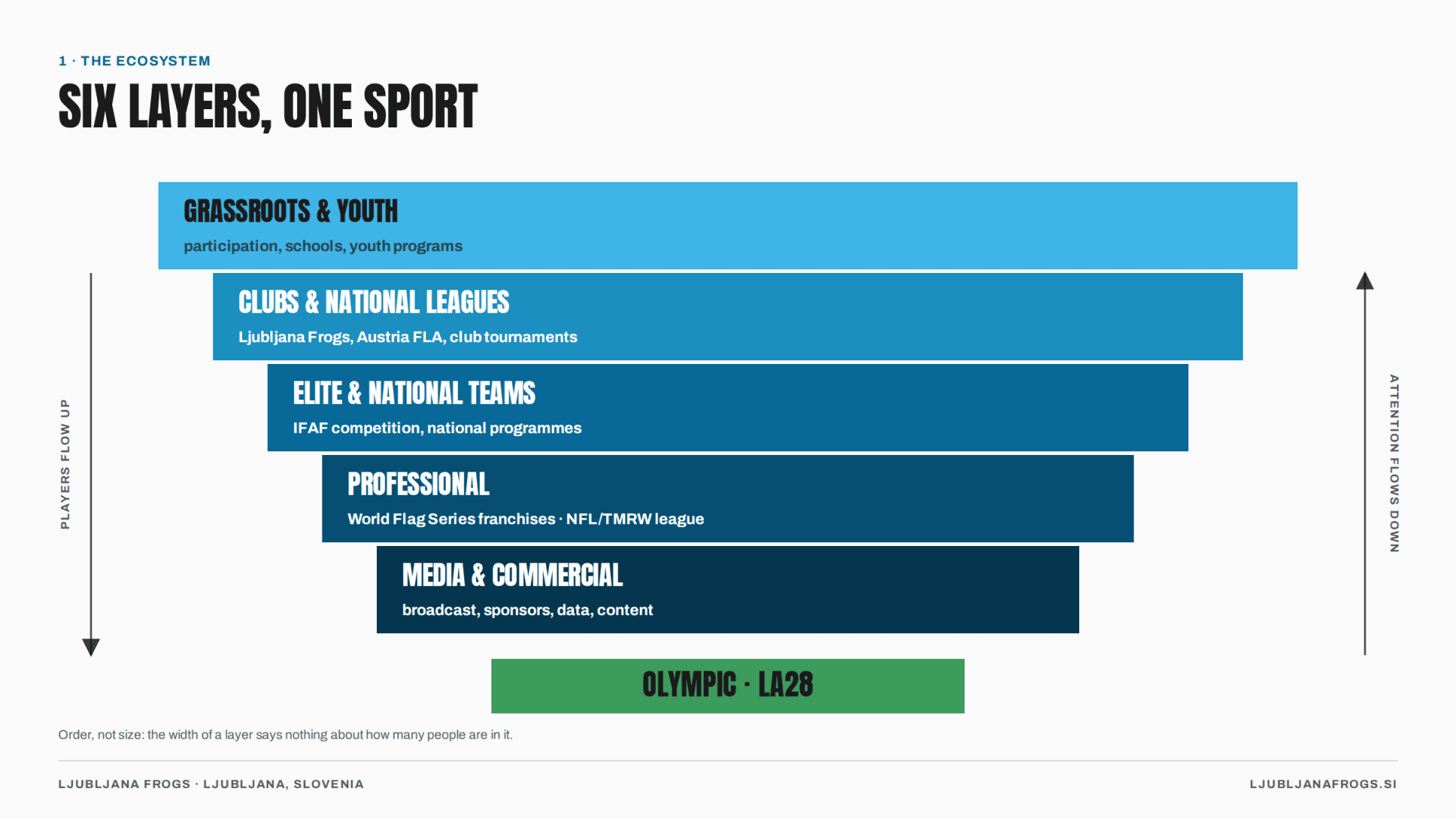
Will professional flag football eventually have one global league? A North American league plus a European league? Regional leagues feeding into a global championship? A franchise system? Or a tournament-based model?
We already have evidence that multiple models can coexist.
World Flag Series launched with three professional franchises, 30 athletes representing 14 countries and a five-game single-night format. Its second event expanded the franchise field.
Meanwhile, the NFL/TMRW Sports league is being developed as a new professional property for both women and men, with a purpose-built venue and a technology-heavy broadcast proposition.
That means the sport is currently in an experimentation phase.
The next five years will reveal which formats can sustain audiences, athletes, sponsors and economics.
2. Will Europe get its own professional franchises?
This might be the biggest question for European flag football.
If professional flag football becomes geographically structured, Europe is too important to ignore.
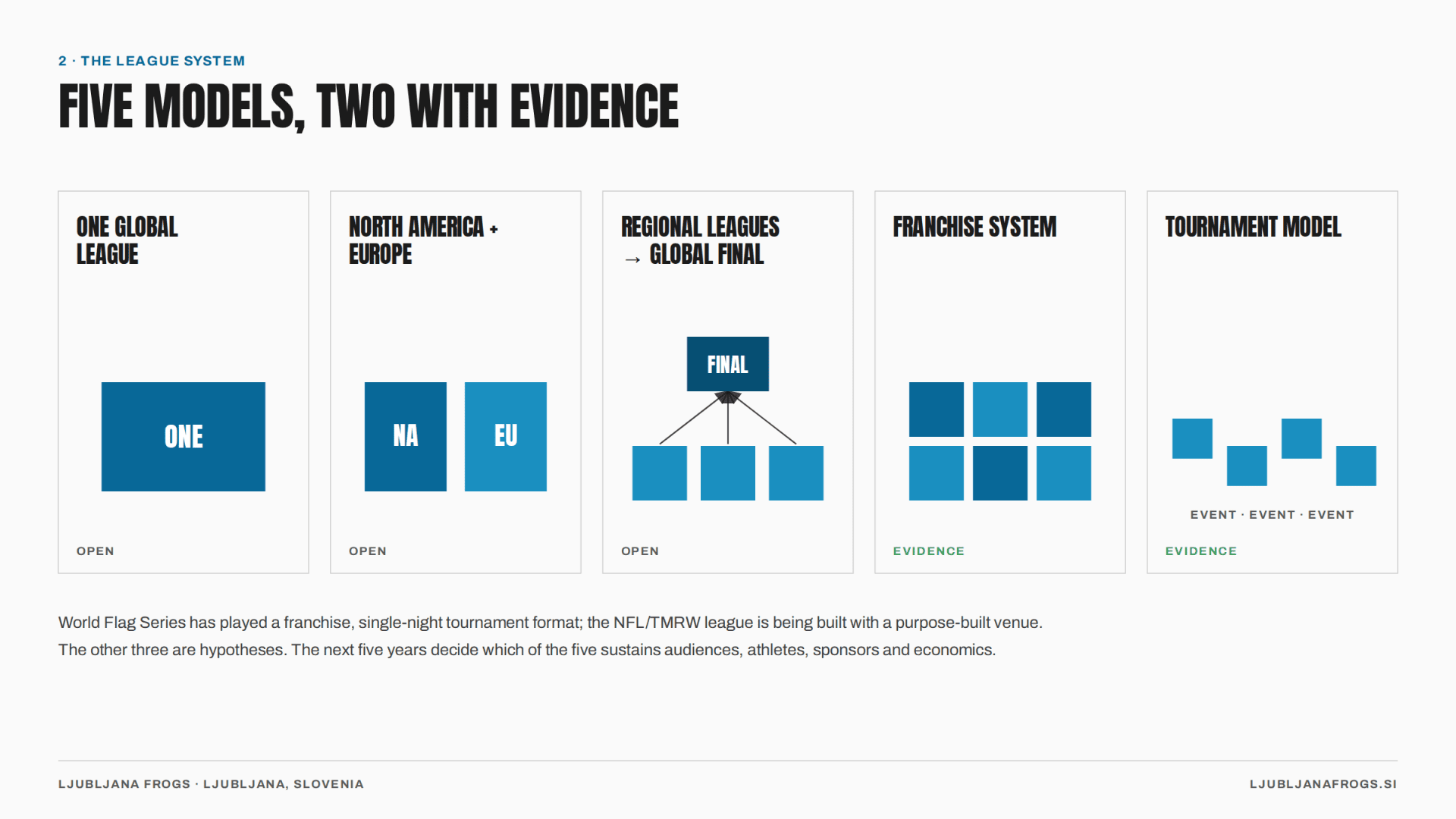
But what does a European professional franchise actually mean?
- London?
- Madrid?
- Paris?
- Berlin?
- Amsterdam?
- Milan?
- Copenhagen?
- Vienna?
- Ljubljana?
Or would European franchises represent regions rather than individual cities?
Who would actually operate them?
- An NFL club?
- A private investor?
- A European sports ownership group?
- An existing flag football organisation?
- A football club?
- A new independent franchise owner?
- A partnership between several of them?
There is currently no public announcement establishing a European franchise structure for the NFL/TMRW professional league. What is public is that TMRW has been evaluating host-city and venue opportunities for its professional league.
Europe does not necessarily need twenty franchises. It may need a smaller number of strategically positioned markets that can actually support a professional sports business.
3. What makes a flag football market viable?
This is where the conversation moves from sport to business.
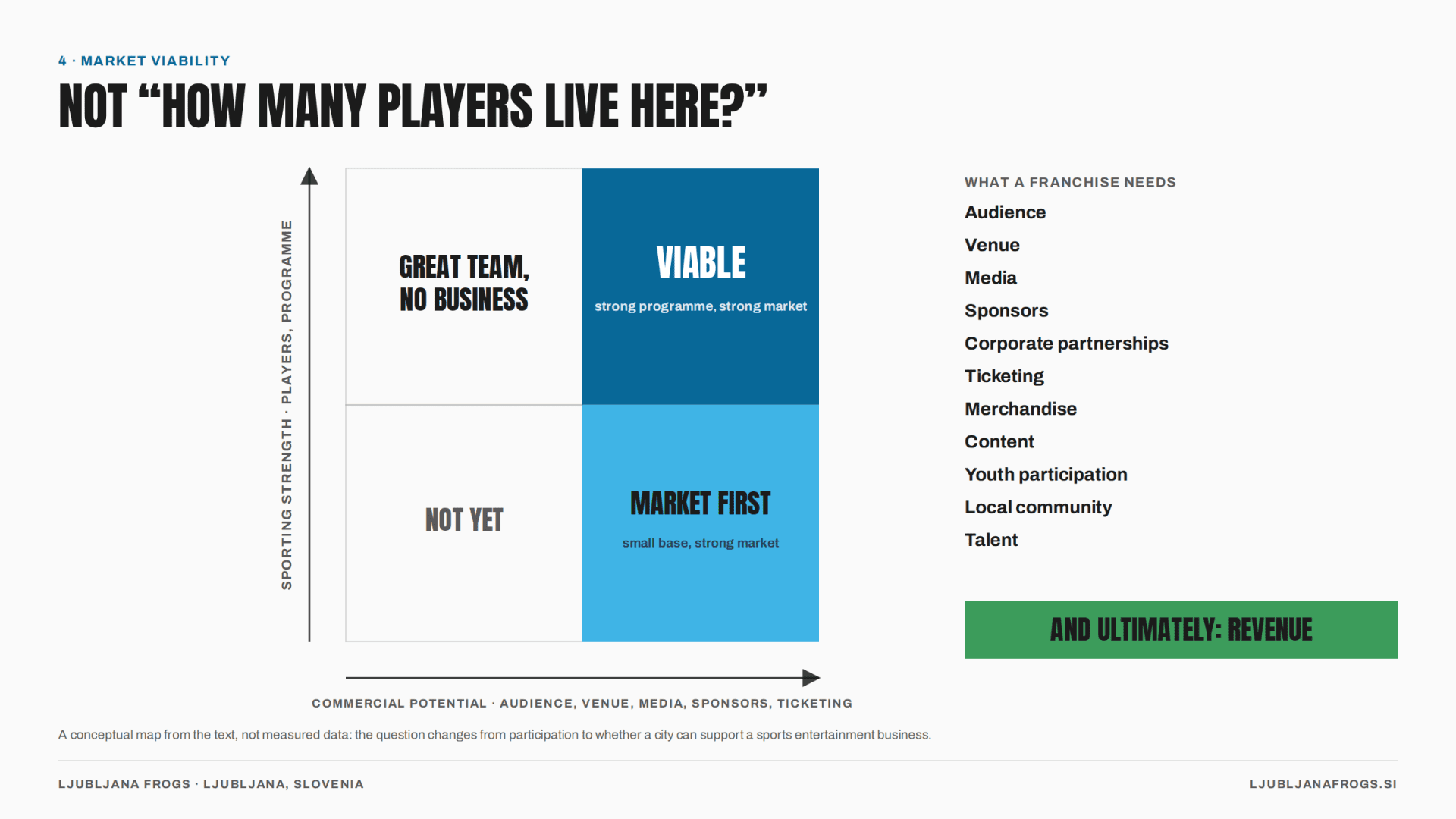
A professional franchise needs more than good players.
- Audience
- Venue
- Media
- Sponsors
- Corporate partnerships
- Ticketing
- Merchandise
- Content
- Youth participation
- Local community
- Talent
And ultimately:
Revenue.
A franchise might have an excellent national-team programme and still fail commercially. Conversely, a market might have relatively small existing participation but strong commercial potential.
This means professional flag football could eventually create a new type of sports-market analysis.
Not “How many players live here?”
“Can this city support a modern sports entertainment business?”
4. How do you attract sponsors to flag football?
The traditional sponsorship pitch is simple: put your logo on our jerseys.
That probably isn't enough for the next generation of professional flag football.
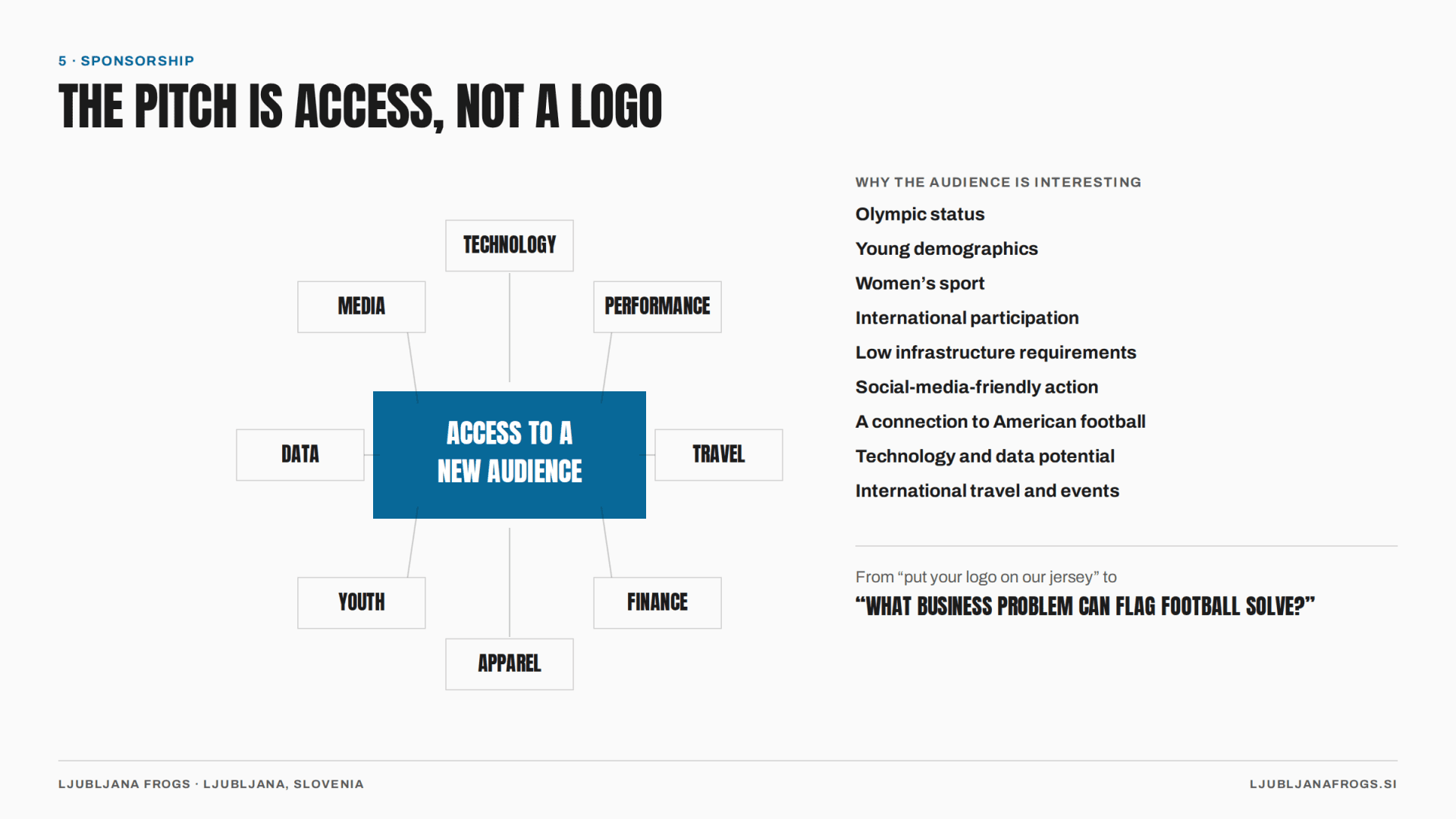
The more interesting proposition is access to a new audience.
Flag football combines several characteristics that can make it commercially interesting:
- Olympic status
- Young demographics
- Women's sport
- International participation
- Relatively low infrastructure requirements
- Social-media-friendly action
- A connection to American football
- Technology and data potential
- International travel and events
The NFL/TMRW professional concept is being developed around technology, data-driven storytelling, media and brand opportunities.
So the question is not simply:
“Who wants to sponsor flag football?”
It is:
“What business problem can flag football help a sponsor solve?”
5. Does professional flag football need to be profitable?
This could completely change the sport.
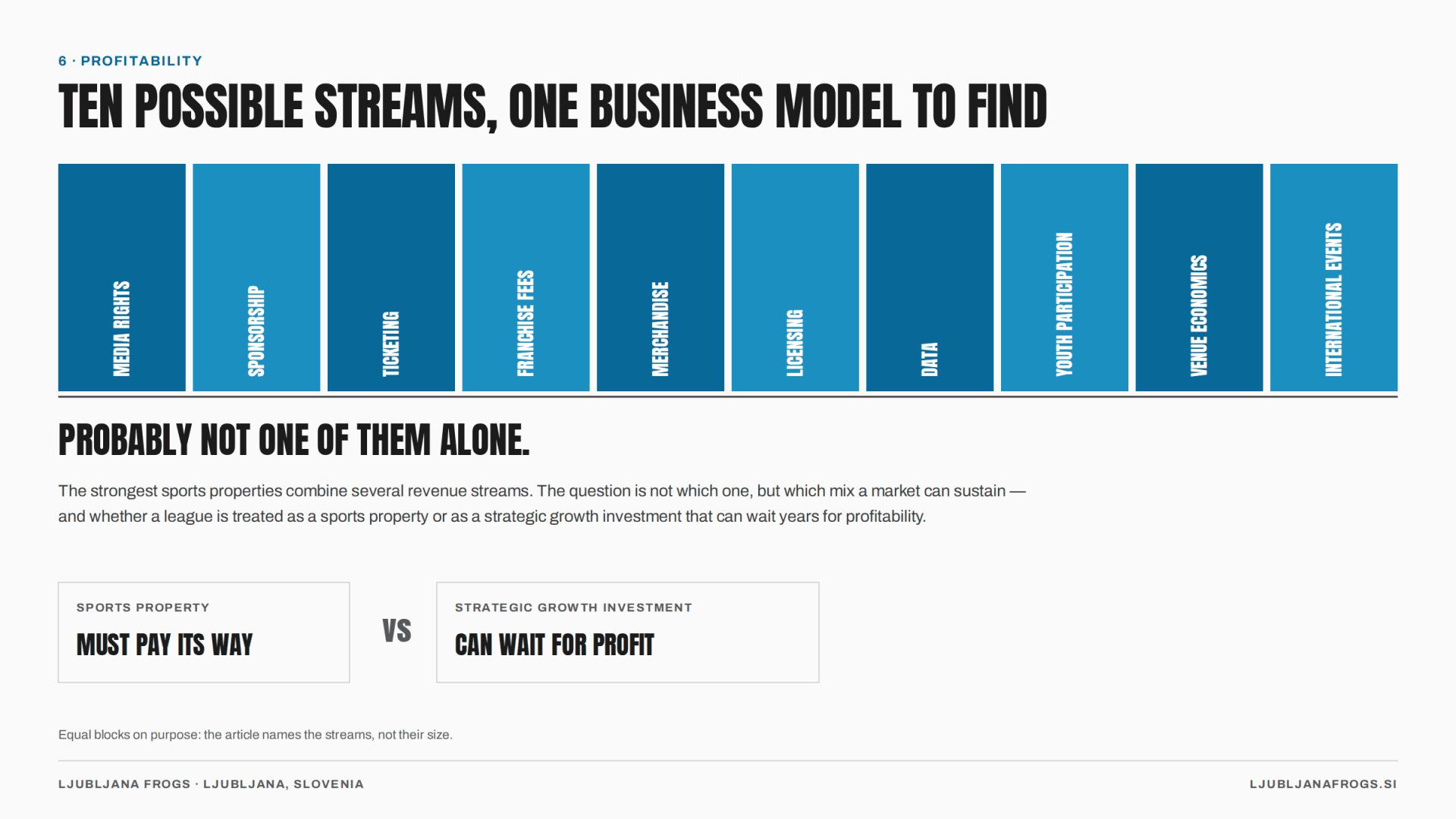
The next five years may determine whether professional flag football is treated primarily as a sports property or as a strategic growth investment.
Those are very different things.
A league backed by major investors can potentially spend years building audiences before demanding profitability.
But eventually someone will ask:
What is the business model?
- Media rights?
- Sponsorship?
- Ticketing?
- Franchise fees?
- Merchandise?
- Licensing?
- Data?
- Youth participation?
- Venue economics?
- International events?
Probably not one of them alone.
The strongest sports properties tend to combine several revenue streams.
6. The five-year test
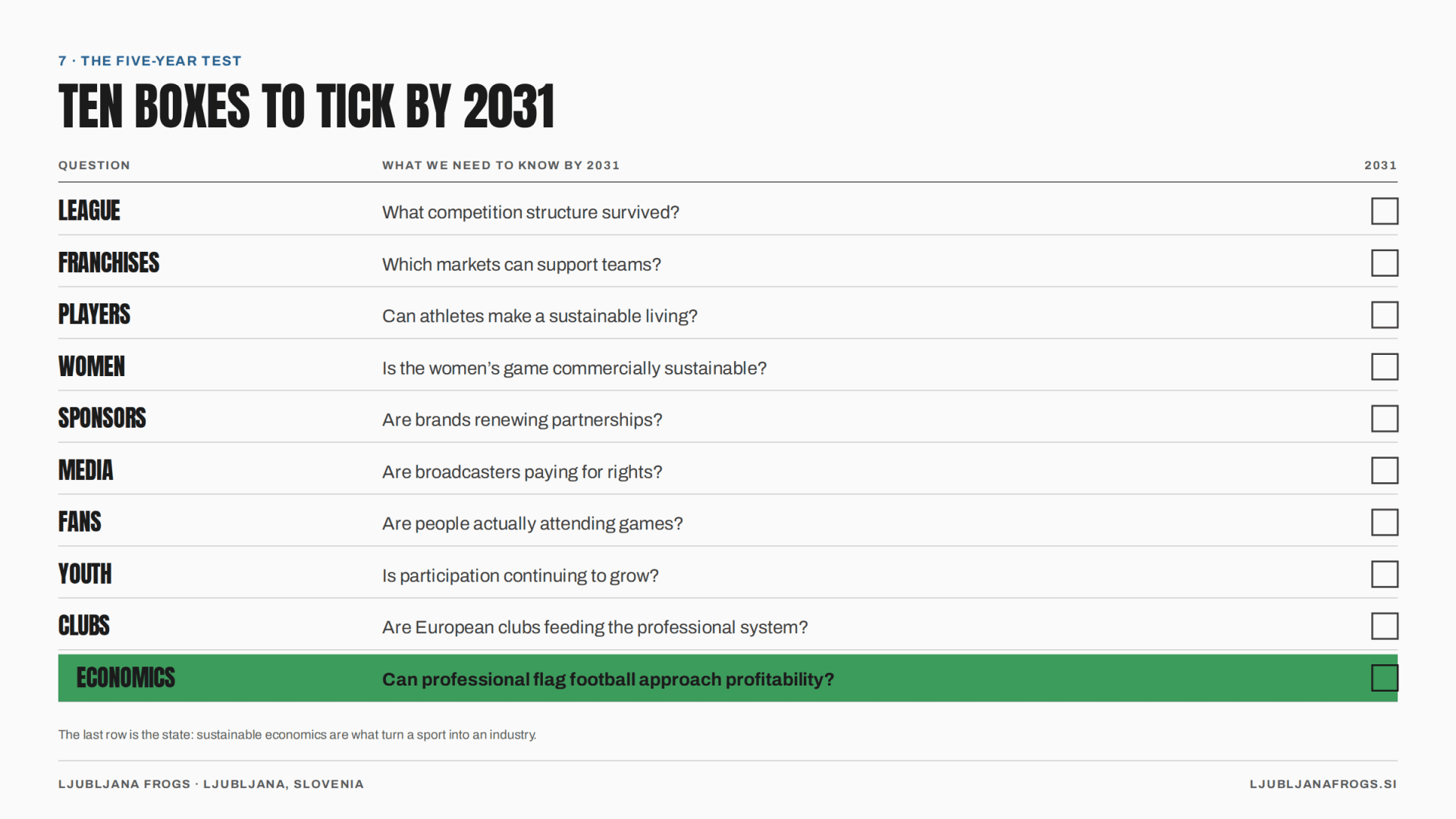
By 2031, we should have a much clearer picture.
| Question | What we need to know |
|---|---|
| League | What competition structure survived? |
| Franchises | Which markets can support teams? |
| Players | Can athletes make a sustainable living? |
| Women | Is the women's game commercially sustainable? |
| Sponsors | Are brands renewing partnerships? |
| Media | Are broadcasters paying for rights? |
| Fans | Are people actually attending games? |
| Youth | Is participation continuing to grow? |
| Clubs | Are European clubs feeding the professional system? |
| Economics | Can professional flag football approach profitability? |
The last question may ultimately be the most important.
Olympic inclusion can create attention. NFL investment can create infrastructure. Professional leagues can create opportunities. But sustainable economics are what create a sport industry.
7. And where do European clubs fit?
This is where Ljubljana Frogs becomes particularly relevant.
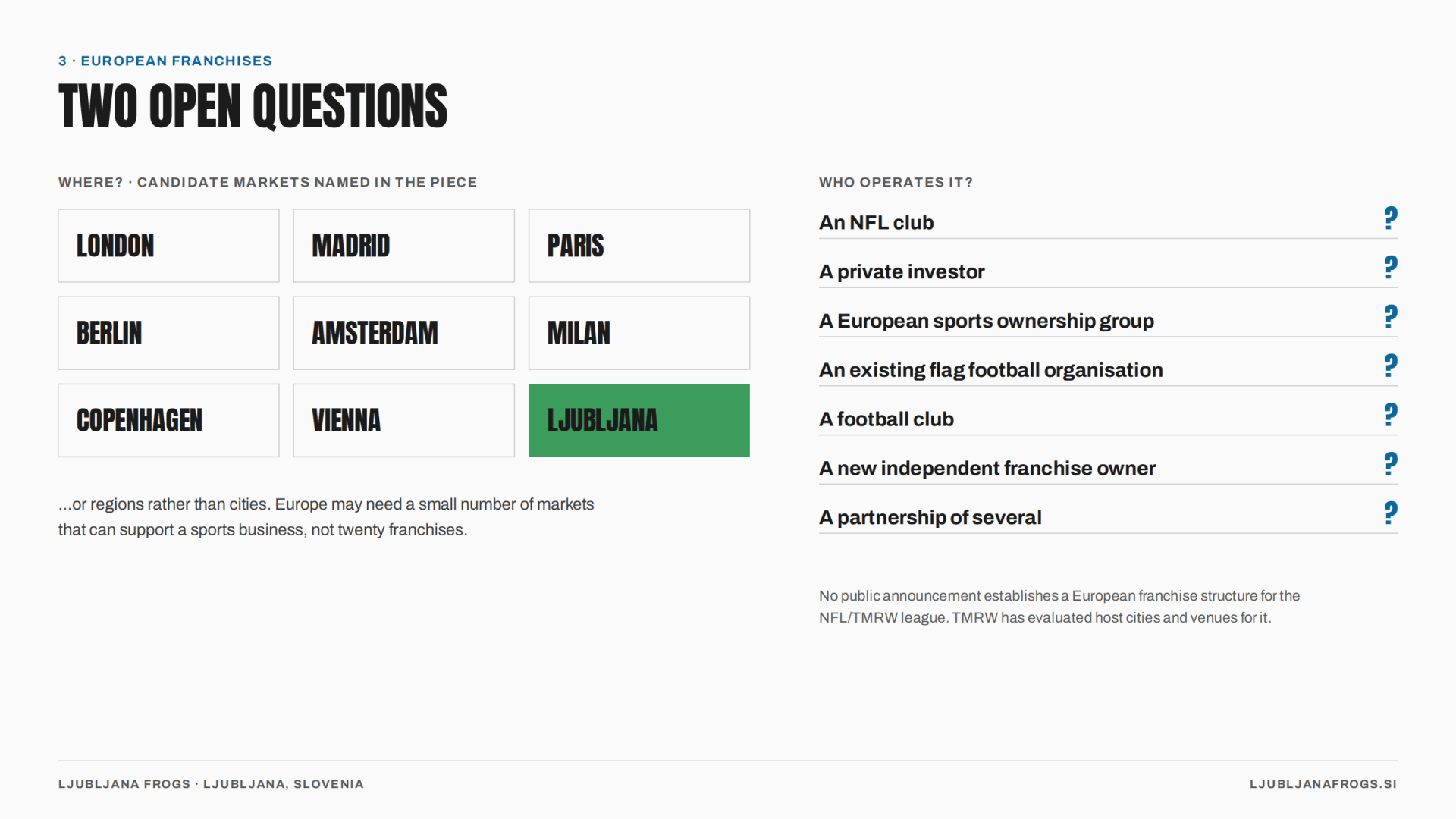
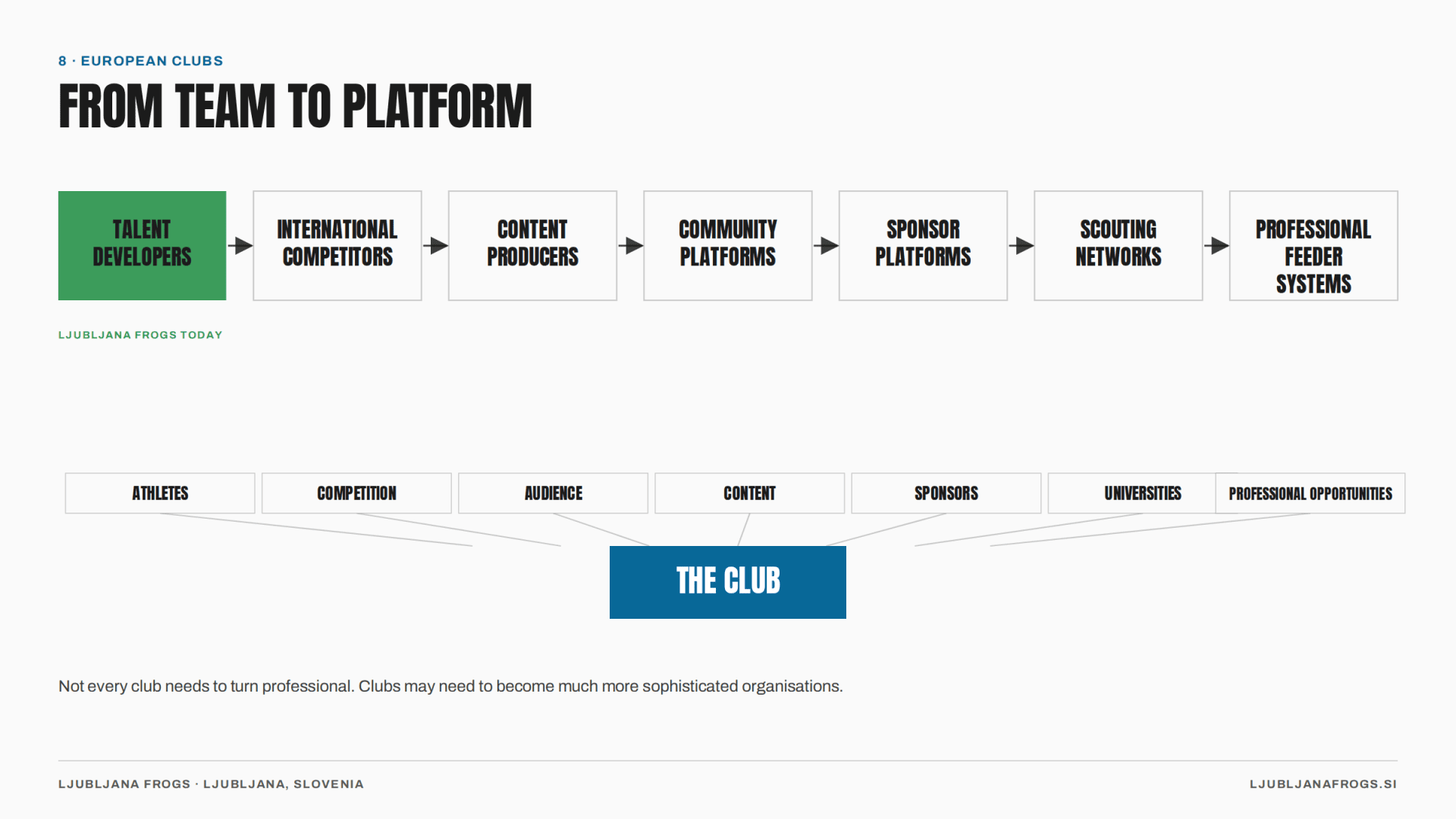
European clubs could become:
Talent developers → international competitors → content producers → community platforms → sponsor platforms → scouting networks → professional feeder systems
That does not necessarily mean every club needs to become professional.
It means clubs may need to become much more sophisticated organisations.
8. The biggest opportunity may not be the professional league
The professional league will receive most of the attention.
But professional leagues need an ecosystem underneath them.
- Players
- Coaches
- Officials
- Clubs
- Tournaments
- Universities
- National teams
- Youth programs
- Content creators
- Sponsors
- Facilities
That ecosystem is being built now.
IFAF and TMRW Sports' partnership explicitly addresses athlete development, competition pathways and fan engagement across the emerging flag football landscape.
So perhaps the biggest European opportunity isn't simply:
“Who gets the first European franchise?”
It is:
“Who builds the infrastructure that produces the players, audiences and commercial value those franchises will eventually need?”
9. And that changes the question for Ljubljana Frogs
For a club like Ljubljana Frogs, the strategic question isn't simply:
Can we win tournaments?
It becomes:
Can we build a platform that matters in the next version of European flag football?
That means thinking about:
- Performance
- Player development
- International competition
- Content
- Community
- Sponsors
- Universities
- International partnerships
- Data
- Talent identification
And potentially, one day:
Professional player development.
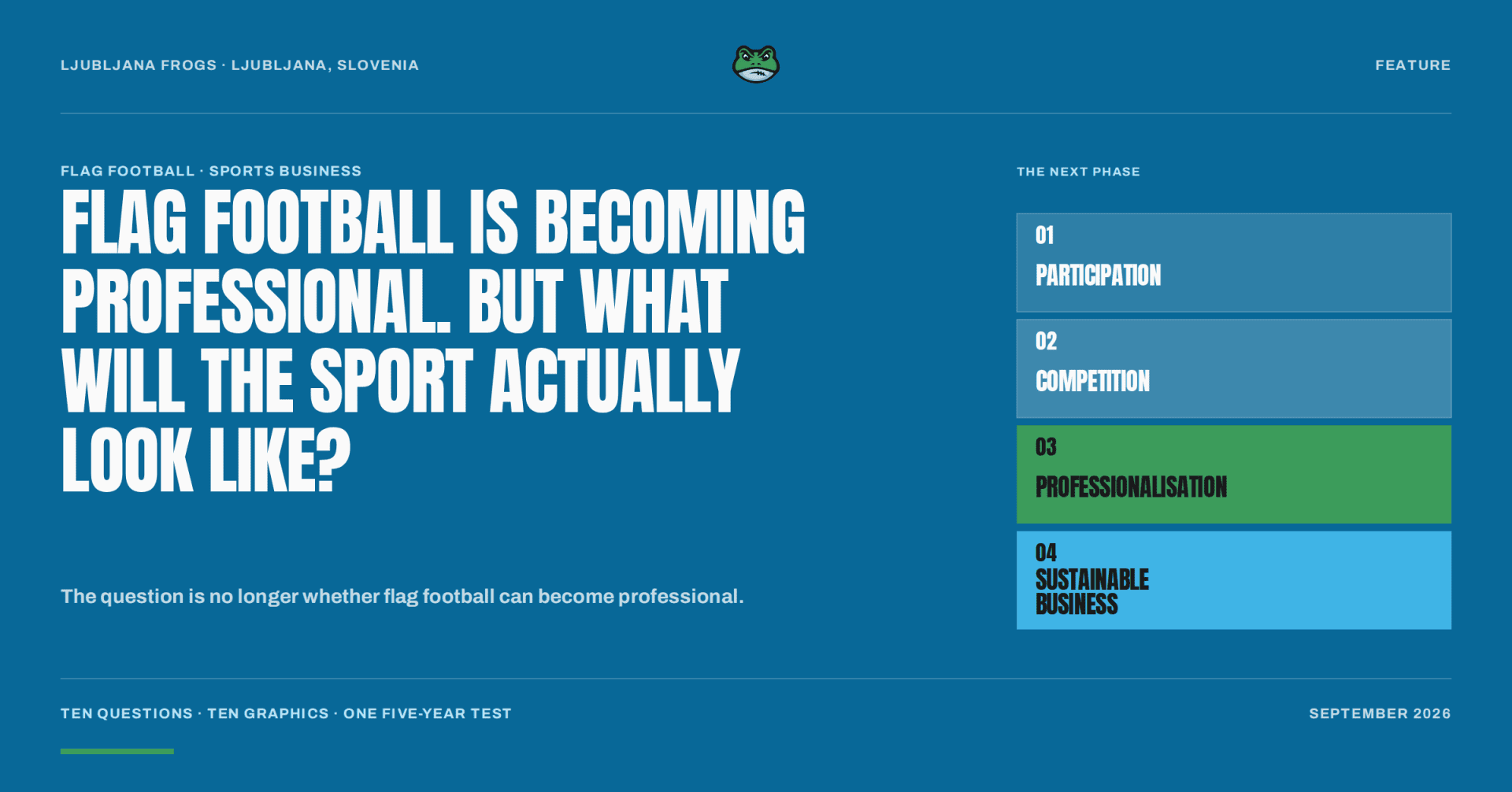
10. The next phase of flag football
The first phase was about participation.
The second was about competition.
We are now entering the phase of professionalisation.
And the next phase will probably be about something much harder:
Building a sustainable sports business.
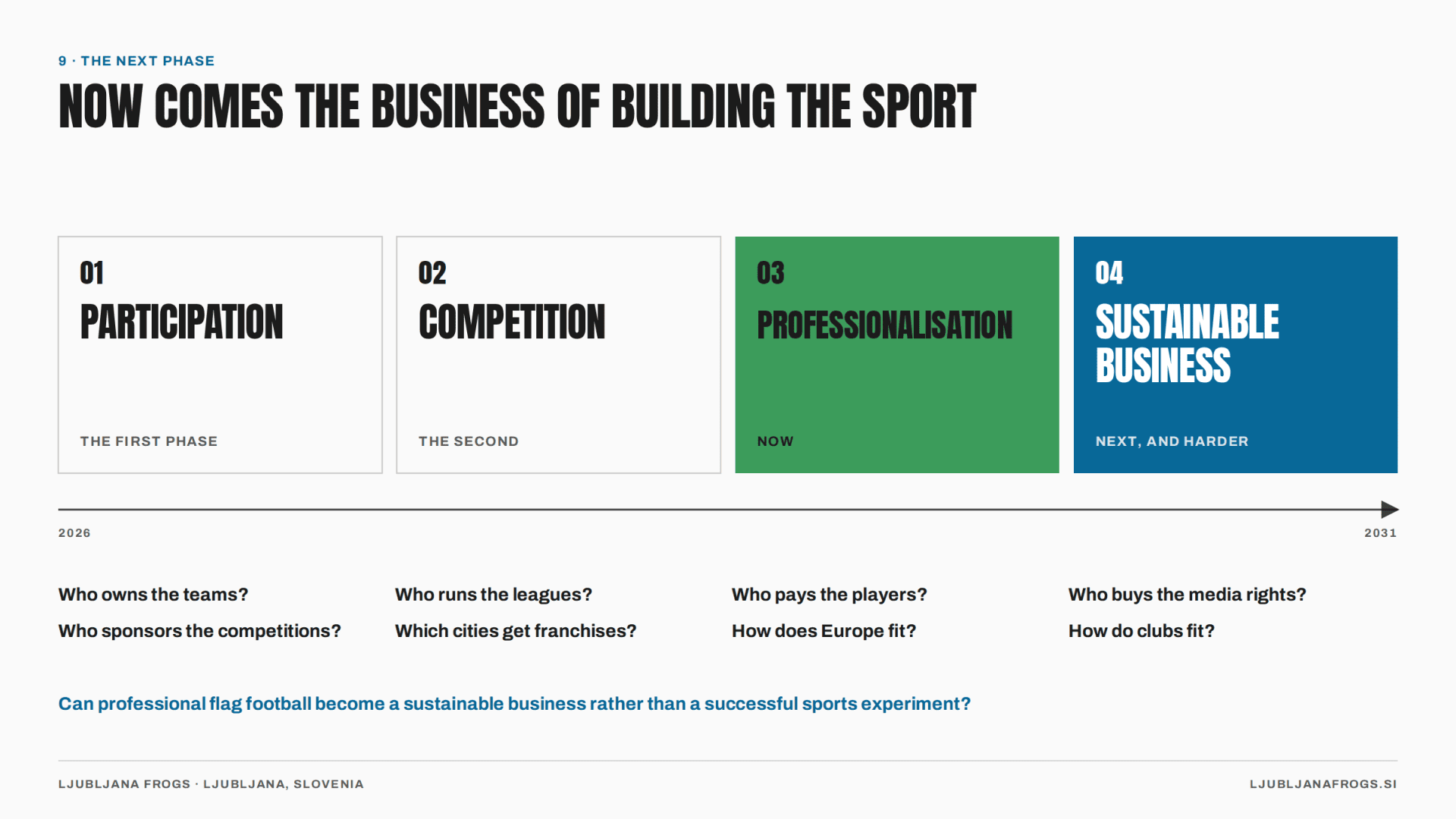
- Who owns the teams?
- Who runs the leagues?
- Who pays the players?
- Who buys the media rights?
- Who sponsors the competitions?
- Which cities get franchises?
- How does Europe fit?
- How do clubs fit?
And ultimately:
Can professional flag football become a sustainable business rather than simply a successful sports experiment?
Those questions are much more interesting than whether flag football is “growing.”
Because the growth story is already happening.
Now comes the business of building the sport.
Sources
- NFL / TMRW Sports — professional flag football league announcement
- IFAF / TMRW Sports — strategic partnership for global flag football development
- World Flag Series — professional competition and franchise information
- TMRW Sports — professional league, venue and host-market development
Ready to hit the field?
Join our diverse roster. No experience needed to start training with us.
Join the teamFollow the Frogs on Instagram
Training clips, matchday moments, and the road to LA28 — join 10K+ followers keeping up with the team between games.
Follow @ljubljanafrogs_flagfootballKeep Exploring
Continue the story
Jump from this article into the roster, match center, and content hubs that give the story more context.
Content hub
News
See more reporting, analysis, and related stories from this track.
Open hubPlayer profile
Aljoša Kous
Move from the article into the player page, profile details, and season context.
Open profileLatest result
Bears vs Ljubljana Frogs — Domestic team
Open the result page for score context, then drill into the match center if needed.
Open result